Why Are Mini LED Monitors Better Than Normal LED
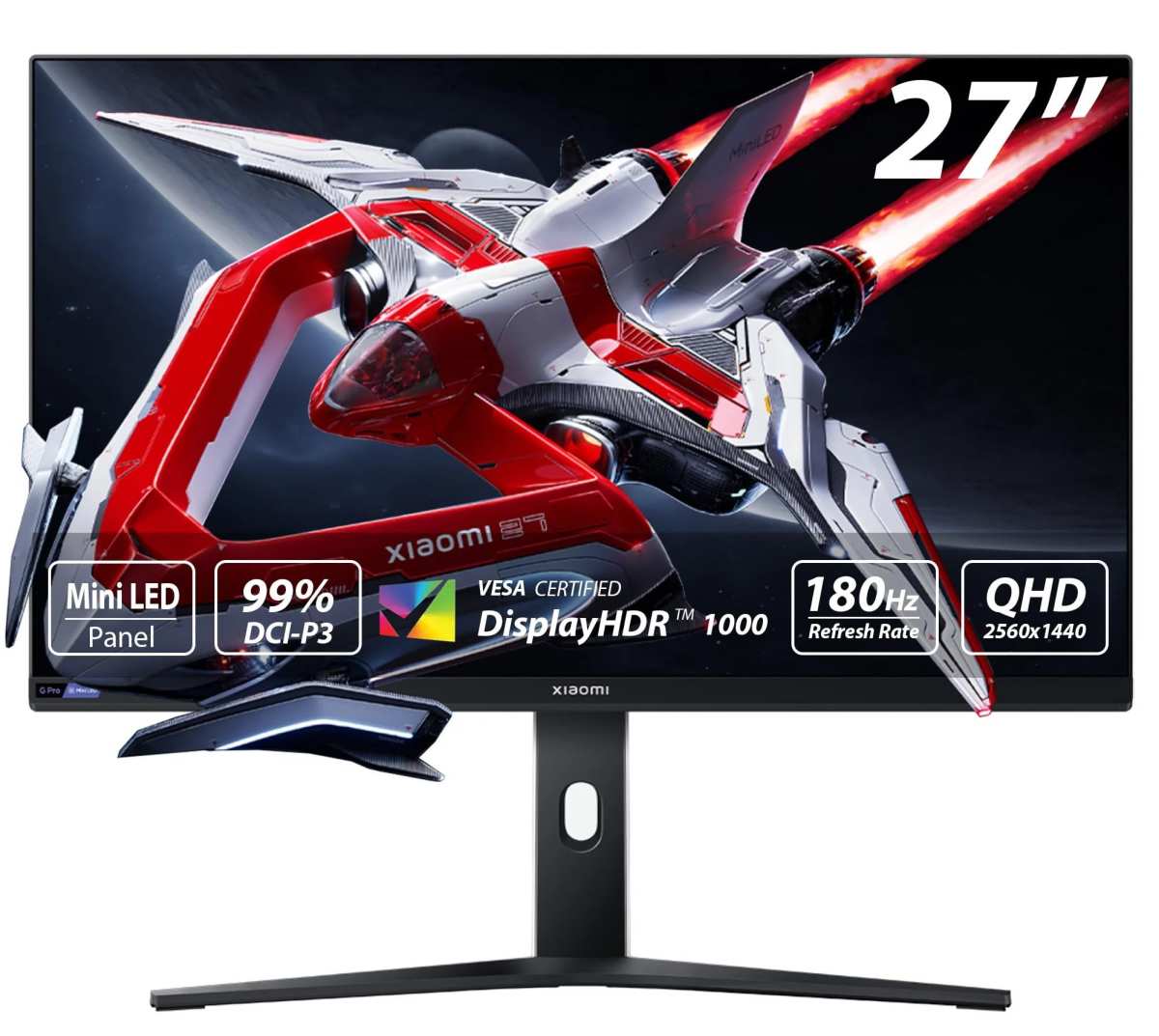
When you're trying to understand why are mini led monitors better than normal led, it really comes down to one thing: how the backlight is controlled behind the screen. Mini LED monitors use thousands of tiny LED zones that dim and brighten independently, which means deeper blacks, brighter highlights, and an HDR experience that standard edge-lit monitors simply can't match. The trade-off is cost, and some blooming won't suit every viewer.
VESA's DisplayHDR standard sets clear benchmarks for this. Standard LED monitors typically hit 250 to 350 nits, while Mini LED models routinely push past 1,000 nits in HDR mode. That gap is what separates "HDR-compatible" from HDR that actually looks right.
Image source: Bing (Web)
Quick Answer
Mini LED monitors offer superior brightness, contrast, and HDR performance compared to standard LED monitors. They pack thousands of dimming zones for precise backlight control, delivering true deep blacks and bright highlights simultaneously. For HDR content, professional work, or gaming, they're a clear step up from standard LED.
Why Mini LED Monitors vs Standard LED Actually Matters
The gap between these two backlight technologies isn't incremental. It's structural. An edge-lit LED monitor runs a strip of LEDs along one edge of the panel and relies on a diffuser layer to spread light across the whole screen.
That means you get roughly one to four dimming zones, at best. The entire backlight dims or brightens together, which crushes your contrast ratio and makes real HDR impossible.
Mini LED changes the game by cramming thousands of individual LEDs directly behind the LCD layer. Each one can be controlled independently, or grouped into local dimming zones. That granular control lets the screen show a bright white star against a genuinely dark night sky, all on the same frame.
A standard LED set can't do that because its backlight is always partially illuminating the dark areas.
For anyone working with HDR media, doing color-critical creative work, or just wanting a more cinematic viewing experience, this distinction is what separates a passable HDR display from one that actually delivers on the promise.
How Mini LED Backlighting Actually Works (And Why It's Different)
The Core Technical Difference
Standard LED monitors use a backlight made of relatively large LED chips arranged along the edges of the display. Light bounces through a series of diffusion films and light-guide plates to reach your eyes. The problem?
Those films can't fully block light from bleeding into dark areas of the image. That's why older LED monitors often exhibit a glow or grey wash in dark scenes.
Mini LED shrinks each individual LED chip down to roughly 0.2mm or smaller, packing far more of them into the same space. This isn't just a density upgrade. It enables full-array local dimming (FALD), where each zone operates independently based on what the content demands.
More zones mean finer control, less light bleed, and dramatically higher contrast.
Local Dimming Zones Explained
Local dimming zones are the heart of Mini LED's advantage. Each zone corresponds to a cluster of Mini LED chips that receive their own brightness instructions from the monitor's processing chip. When a scene shows a dark room with a single lit candle, the zones behind the candle stay bright while the surrounding zones dim or shut off completely.
Budget Mini LED monitors might ship with 384 zones or fewer, which already beats edge-lit options by orders of magnitude. Premium models push past 2,000 zones, approaching per-pixel control in practice. The more zones you have, the fewer artifacts you see, and the closer you get to that perfect black-and-white simultaneous output.
Why Zone Count Matters More Than You Think
Zone count directly determines how precisely the monitor controls light across the panel. Too few zones and you get blooming, where a bright object creates a visible halo of light spilling into the surrounding dark area. This is the most common complaint with Mini LED, and it's why zone count and the quality of the local dimming algorithm both matter.
A 384-zone Mini LED can look noticeably better than a standard edge-lit monitor in HDR mode. A 1,152-zone model, like those found in Apple's Pro Display XDR or the Acer Predator X35 S, handles specular highlights and fine text against dark backgrounds with far less haloing. Meanwhile, OLED still wins on per-pixel precision because it has no backlight at all, but Mini LED gets much closer than any standard LED technology can.
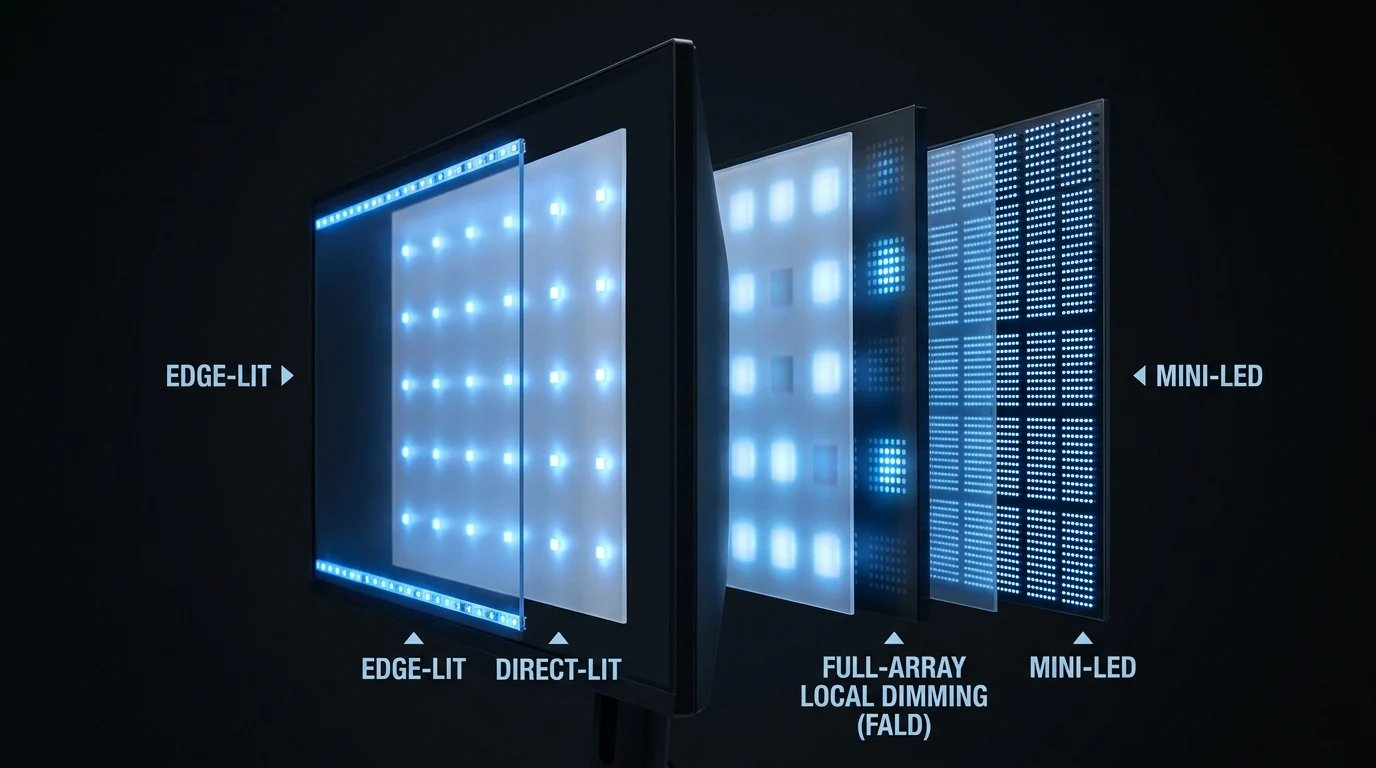
Image source: Bing (Web)
Side-by-Side Comparison: Mini LED vs Standard LED
Performance Breakdown Table
Here's how these two backlight technologies stack up side by side on the specs that actually matter for real-world use.
| Performance Factor | Standard LED Monitor | Mini LED Monitor | Advantage |
|---|---|---|---|
| Peak Brightness | 250 to 350 nits (typical) | 600 to 2,000+ nits | Mini LED (2-6x brighter) |
| Local Dimming Zones | 1 to 4 (edge-lit) | 384 to 2,304+ | Mini LED (orders of magnitude better) |
| Native Contrast Ratio | 1,000:1 (IPS) to 3,000:1 (VA) | Effectively 100,000:1+ with local dimming | Mini LED |
| HDR Capability | Limited, DisplayHDR 400 | DisplayHDR 600 to 1400 | Mini LED |
| Black Level | 0.1 to 0.3 nits (edge-lit) | Under 0.05 nits (per zone, fully dimmed) | Mini LED |
| Blooming/Haloing | None (uniform backlight) | Present, varies by zone count and algorithm | Standard LED (cleaner darks) |
| Price Range (27-inch) | $150 to $400 | $400 to $2,000+ | Standard LED |
| Power Consumption | 20 to 40W | 50 to 200W (varies with HDR content) | Standard LED |
| Color Gamut (typical) | 99% sRGB, 85-95% DCI-P3 | 99% DCI-P3, 95%+ Adobe RGB | Mini LED |
Standard LED hasn't disappeared because it still does the job for everyday use. Web browsing, office documents, email, spreadsheets, all of these work perfectly well on a backlit LED monitor at 300 nits. You don't need 1,600 nits of peak brightness to edit a Word document.
But the second you open an HDR movie, a modern game with HDR10 support, or a RAW photo with specular highlights in a shadow scene, the difference becomes instantly obvious.
What You'll Actually See on Screen
Manufacturers love to throw around marketing terms like "dynamic contrast ratio" and "HDR-ready," but the practical difference is straightforward. On a Mini LED monitor, sunset scenes glow with blinding brightness while the sky around them stays deep and dark. Text pops against dim backgrounds without a grey fog washing out the edges.
Standard LED screens simply can't maintain that separation because the entire backlight unit is sharing the same brightness level across the whole panel at any given moment.
Benefits of Mini LED Over Standard LED Monitors
HDR Performance That's Actually Real
Let's be honest about HDR on standard LED monitors. Most budget and mid-range models that carry an HDR badge are technically "HDR-compatible," meaning they can accept an HDR signal but can't display the full dynamic range. A DisplayHDR 400 monitor peaks at 400 nits and lacks local dimming.
That's not HDR as the format was intended.
Mini LED changes this equation completely. Models certified at DisplayHDR 1000 or DisplayHDR 1400 deliver 1,000 to 1,400 nits of peak brightness on small windows, combined with deep local-dimming blacks. This creates the kind of simultaneous contrast that makes highlights genuinely pop against dark backgrounds.
Per VESA's own testing framework, the jump from DisplayHDR 400 to DisplayHDR 1000 represents a visible, measurable improvement in HDR rendering.
For HDR gaming on titles like Cyberpunk 2077, Alan Wake 2, or Forza Horizon 5, the difference is striking. Neon signs glow with real intensity while night scenes retain detail in the shadows. Standard LED monitors either blow out the highlights or crush the shadows because they lack the dynamic range to render both in the same frame.
Brightness and Contrast You Can See in Real Life
Peak brightness isn't just a spec number. It directly affects how realistic content looks. The sun, reflections, explosions, and bright light sources in games and movies are mastered at high luminance levels.
A monitor that can't reproduce those brightness levels compresses the image and flattens the visual impact.
Mini LED monitors routinely hit 600 to 1,000 nits in sustained HDR content, with some models reaching 2,000 nits on small specular highlights. Standard LED tops out around 300 to 350 nits in most cases. That gap is immediately visible in a side-by-side comparison, even to untrained eyes.
Contrast ratio tells a similar story. A standard IPS panel with edge-lit LED backlight delivers a native contrast ratio around 1,000:1. That means the brightest white is one thousand times brighter than the darkest black.
With full-array local dimming active, Mini LED monitors achieve effective contrast ratios exceeding 100,000:1. Some manufacturers claim ratios in the millions, though those numbers depend on measurement methodology.
When Edge-Lit LED Falls Short
Edge-lit LED works fine for well-lit environments where you're doing basic tasks. Office work, web browsing, video calls, and streaming SDR content all look perfectly acceptable on a standard LED monitor. The limitations show up when the content demands a wide dynamic range.
Dark movie scenes lose detail because the backlight can't fully dim behind dark content. Bright objects on dark backgrounds exhibit a uniform grey wash instead of true black. HDR content either looks washed out or forces you to choose between preserving highlights and retaining shadow detail.
These aren't subtle differences. They're fundamental limitations of the edge-lit architecture.
Where Mini LED Falls Short (Honest Drawbacks)
Blooming and Haloing Issues
Blooming is the most talked-about weakness of Mini LED technology, and it's a real issue. When a bright object appears against a dark background, light from the illuminated zone bleeds into adjacent zones, creating a visible halo or glow around the object. White text on a black screen, subtitles in a movie, and cursor movement on a dark desktop are common triggers.
The severity depends on two factors: zone count and the local dimming algorithm. A 384-zone Mini LED will show more blooming than a 2,304-zone model. Some manufacturers use aggressive dimming algorithms that minimize blooming but crush shadow detail.
Others use conservative approaches that preserve detail but let more light bleed through.
This is one area where standard edge-lit LED actually has an edge. Since the entire backlight is uniformly lit, there's no zone boundary to create halos. The trade-off is that you get grey blacks instead of deep ones, but at least you don't get distracting glows around bright objects.
The Price Premium Reality
Mini LED monitors cost significantly more than their standard LED counterparts. A 27-inch 4K Mini LED monitor with decent zone count starts around $400 to $500. A comparable standard LED 4K monitor can be found for $200 to $300.
Premium Mini LED models with high zone counts and professional features can run $1,000 to $3,500 or more.
For professional content creators who need accurate HDR monitoring, the price premium is often justified. For general users who browse the web and watch YouTube, it's harder to justify the extra cost. The value proposition depends entirely on what you're doing with the monitor and whether you'll actually benefit from the improved contrast and brightness.
Power Draw and Heat Considerations
Driving thousands of individual LED zones requires more power and generates more heat than a simple edge-lit backlight. Mini LED monitors typically consume 50 to 200 watts during HDR content, compared to 20 to 40 watts for standard LED models. Some high-end models with full-array local dimming at peak brightness can draw even more.
This increased power consumption means more heat output, which is why many Mini LED monitors have thicker chassis with built-in ventilation. For users in small spaces or those concerned about energy costs, this is worth factoring into the decision.
Best Monitor Types for Different Users
Content Creators and Color Professionals
If you're editing video for HDR delivery, grading color for cinema or streaming, or working in photography where accurate highlight and shadow reproduction matters, Mini LED is a strong choice. The combination of high peak brightness, wide color gamut coverage (often 99% DCI-P3 or better), and local dimming makes it suitable for professional HDR mastering.
Models with hardware calibration support and factory-calibrated Delta E values below 2 are particularly worth considering. The ability to trust what you're seeing on screen, especially in the highlights and shadows, is critical for professional work.
HDR Gamers
HDR gaming is where Mini LED shines, both literally and figuratively. Modern AAA titles with HDR10 support benefit enormously from the expanded dynamic range. Explosions, sunsets, neon-lit cityscapes, and dark dungeons all look more immersive when the monitor can actually deliver the brightness and contrast the game engine intended.
Look for models with low response times (1ms to 5ms GTG), high refresh rates (120Hz or above), and HDMI 2.1 support for console gaming. DisplayHDR 1000 certification is a good baseline for a genuinely impactful HDR gaming experience.
General Office and Everyday Use
For email, documents, spreadsheets, web browsing, and video calls, a standard LED monitor is more than sufficient. You won't see meaningful benefits from Mini LED's local dimming or peak brightness in these scenarios. The extra cost and power consumption aren't justified for this use case.
A good 27-inch 4K IPS monitor with edge-lit LED backlight at 300 to 350 nits will serve you well for years. Spend the savings on a better chair or a nicer desk setup instead.
Budget-Conscious Buyers
If your budget is under $300, standard LED is the practical choice. Mini LED monitors at that price point either don't exist or make significant compromises on zone count, brightness, or panel quality. You're better off with a well-reviewed standard LED monitor than a budget Mini LED with poor local dimming implementation.
Cost Breakdown and What You're Actually Paying For
The price gap between Mini LED and standard LED comes down to manufacturing complexity. Mini LED requires picking and placing thousands of tiny LED chips onto a backlight unit, which is far more labor-intensive and precise than attaching a strip of LEDs to the edge of a panel. Each zone needs its own driver circuitry, and the local dimming processor adds additional cost.
Here's a rough breakdown of what you're paying for at different price tiers:
- $150 to $300: Standard LED, 1080p to 4K, 60Hz to 144Hz, edge-lit, no local dimming. Good for general use and casual gaming.
- $300 to $500: Entry-level Mini LED, 4K, 60Hz to 144Hz, 384 to 576 zones, DisplayHDR 600 to 1000. Decent HDR for the price, but expect some blooming.
- $500 to $1,000: Mid-range Mini LED, 4K, 144Hz+, 576 to 1,152 zones, DisplayHDR 1000. Good HDR performance with manageable blooming. Suitable for serious gaming and semi-professional content work.
- $1,000 to $2,000: Premium Mini LED, 4K to 5K, high refresh rates, 1,152 to 2,304 zones, DisplayHDR 1000 to 1400. Professional-grade HDR with minimal blooming. Used by video editors, colorists, and photographers.
- $2,000+: Flagship Mini LED, high zone counts, reference-grade color accuracy, specialized features. Competes with professional reference monitors.
The sweet spot for most users who want genuine HDR improvement without overspending sits in the $500 to $1,000 range. Below that, you're making too many compromises on zone count. Above that, you're paying diminishing returns unless you have professional requirements.
Common Mistakes When Buying a Mini LED Monitor
Assuming "Mini LED" automatically means good HDR is the most common pitfall. Some budget models use the Mini LED label but ship with so few zones that blooming is severe and the effective contrast improvement is marginal. Always check the zone count before buying.
Ignoring the local dimming algorithm is another mistake. Two monitors with identical zone counts can perform very differently based on how aggressively and quickly the dimming zones respond to content changes. Reading professional reviews that test blooming specifically is more useful than comparing spec sheets alone.
Overlooking panel type is worth mentioning too. A Mini LED backlight paired with a VA panel gives you better native contrast but narrower viewing angles. An IPS panel with Mini LED gives you wider viewing angles but lower native contrast.
Your priority should guide the choice.
Mini LED vs OLED: The Real Comparison
OLED eliminates the backlight entirely. Each pixel produces its own light and can turn off completely for perfect black levels. This gives OLED an inherent advantage in contrast and blooming.
There are no dimming zones to create halos because there are no zones at all.
Mini LED counters with higher peak brightness. OLED monitors typically peak at 600 to 1,000 nits on small windows, while Mini LED can push well beyond that. For HDR content with specular highlights, like sunlight reflecting off water or bright explosions, Mini LED can deliver more impact.
OLED also carries a risk of burn-in with static elements like taskbars and channel logos. Mini LED has no such concern since the LCD layer doesn't degrade the same way. For users who keep the same monitor for years with static UI elements on screen, this matters.
The honest answer is that OLED is better for dark room viewing and per-pixel precision. Mini LED is better for bright rooms, sustained HDR brightness, and long-term reliability. Neither technology is universally superior.
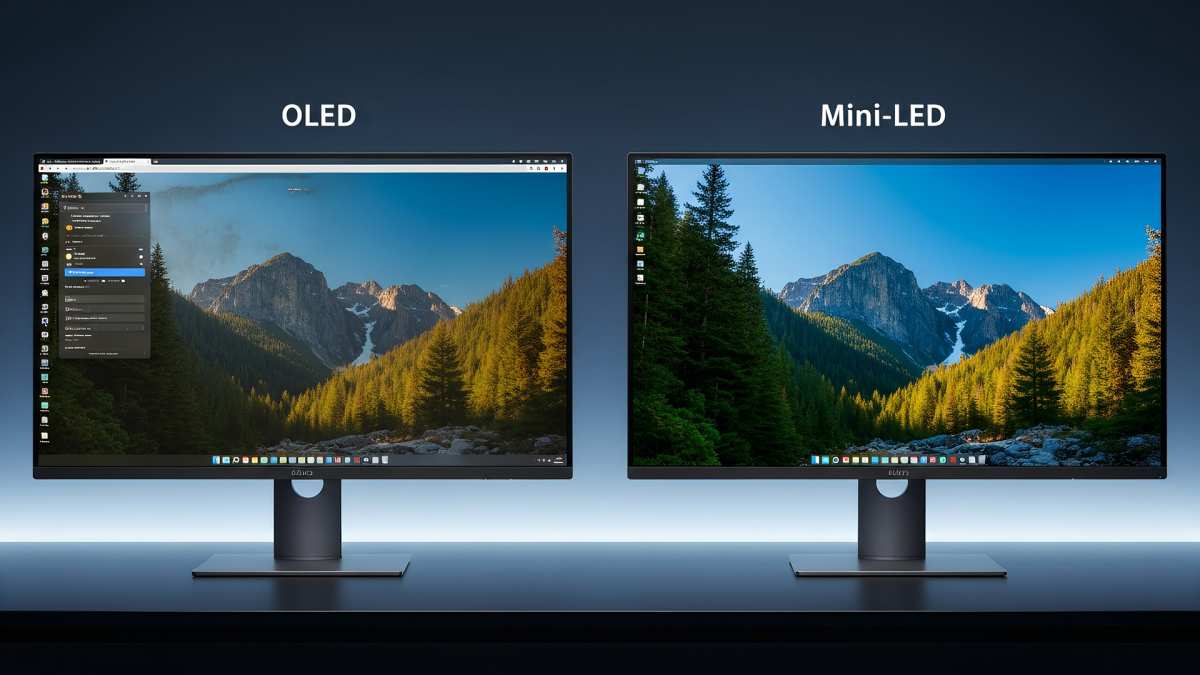
Image source: Bing (Web)
Final Verdict: Who Should Buy Mini LED Right Now?
Mini LED makes sense if you consume HDR content regularly, work in color-critical fields, or game in HDR and want the best brightness a non-OLED display can offer. The technology has matured enough that even mid-range models deliver a visibly superior experience to standard LED in HDR scenarios.
Standard LED remains the right choice for general productivity, casual media consumption, and budget-conscious buyers. You're not missing anything critical for those use cases.
If your budget allows and HDR matters to you, Mini LED is the sweet spot between standard LED and OLED as of 2026. It delivers most of OLED's contrast advantage with better brightness and no burn-in risk.
Image source: Bing (Web)
Frequently Asked Questions
Is Mini LED worth the extra cost over standard LED?
It depends on your use case. For HDR gaming, video editing, and color-critical work, the premium is justified. For general office use and SDR content, standard LED delivers comparable results at a much lower price.
How many dimming zones should I look for?
384 zones is the minimum for a noticeable HDR improvement. 1,000 or more zones is ideal for professional work. Below 384, the blooming can be distracting enough to negate the benefits.
Does Mini LED have burn-in risk?
No. Mini LED is a backlight technology paired with an LCD panel, which doesn't suffer from organic degradation the way OLED does. Static elements on screen won't cause permanent image retention.
Can Mini LED monitors display true blacks?
They can approach very deep blacks by dimming individual zones completely. However, they can't match OLED's per-pixel black levels since some light bleed between zones is always present. The result is still dramatically better than edge-lit LED.
Is Mini LED the same as MicroLED?
No. Mini LED uses small LED chips as a backlight for an LCD panel. MicroLED is a self-emissive technology where each pixel is its own microscopic LED.
MicroLED is still in early stages for consumer monitors and costs significantly more.

Similar Posts