What Is the Advantage of Mini LED Over Lcd
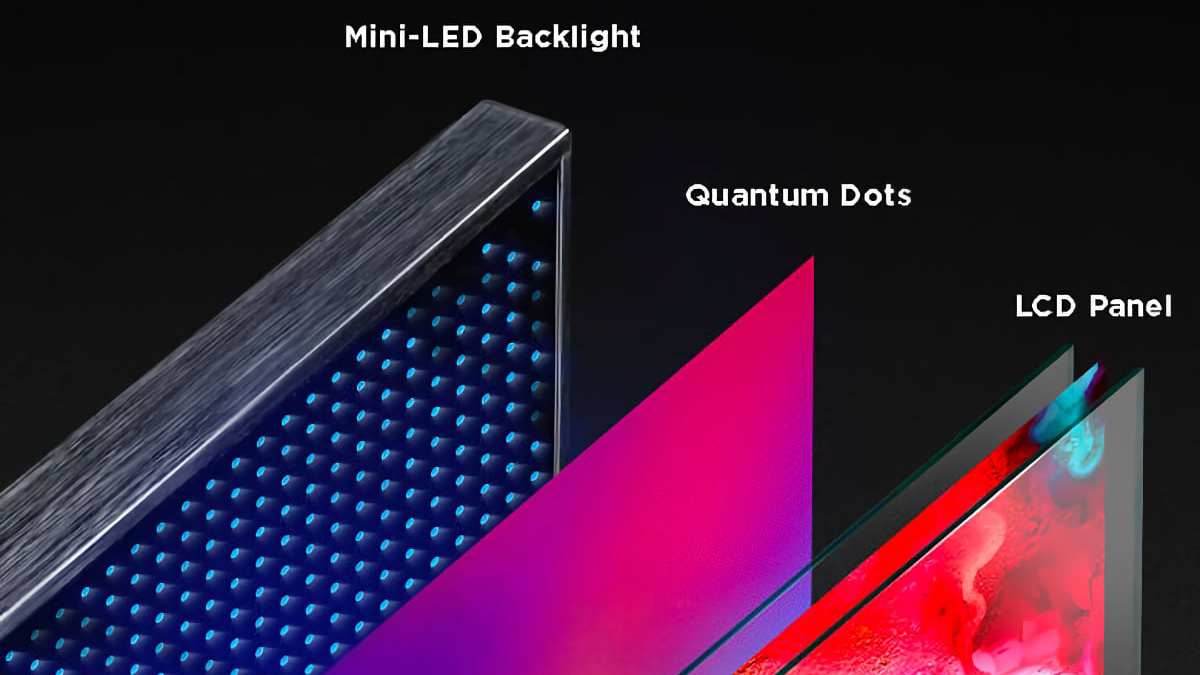
When you're trying to figure out what is the advantage of mini led over lcd, the short answer comes down to one thing: control. Mini LED gives a display far more precision over where light goes on screen, which means deeper blacks, brighter highlights, and a more realistic picture overall. It's still an LCD panel at its core, but the backlight system is fundamentally different and significantly better.
Standard LED-backlit LCDs use a relatively small number of large LED chips, sometimes just a handful along the edge of the screen. Mini LED shrinks those chips down to around 100 to 200 micrometers and packs hundreds or even thousands of them behind the panel. That jump in density is what unlocks the real-world improvements you'll actually notice.
Let's break down exactly how it works and why it matters.
Quick Answer
Mini LED offers better contrast than standard LCD. It uses thousands of tiny LED chips for local dimming. This produces deeper blacks and brighter HDR highlights.
There is no burn-in risk like OLED. Mini LED is ideal for bright rooms and large screens.
How Mini LED Actually Works (And Why It's Different From Regular LED LCD)
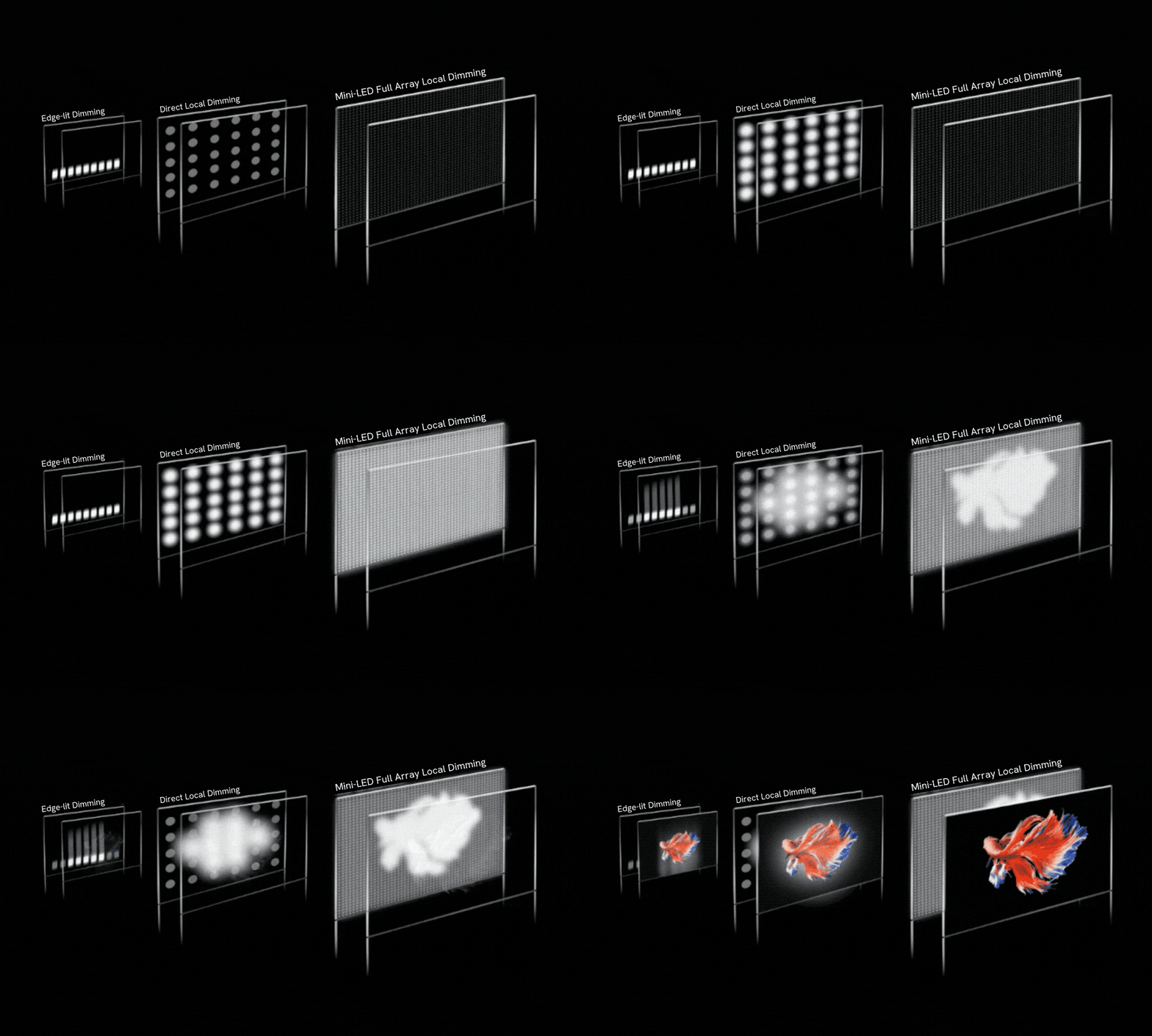
Image source: Bing (Web (fair-use with source credit))
To understand why Mini LED is a step up, you need to understand how a standard LCD produces an image. An LCD panel doesn't make its own light. It's a layer of liquid crystals that opens and closes like tiny shutters to let light through or block it.
The light comes from a backlight unit behind the panel. That backlight is what makes all the difference.
A basic edge-lit LED LCD has LEDs only along one or more edges of the screen. The light spreads across the panel through diffusion layers. The problem is you can't dim one area independently of another.
If a scene shows a bright moon against a black sky, the whole backlight is essentially on. The blacks end up looking gray and washed out.
A direct-lit or Full Array Local Dimming (FALD) LCD improves this by placing LEDs across the entire back of the screen in zones. Each zone can dim or brighten independently. But in a standard FALD LCD, you might only have 50 to 200 zones.
That's better than edge-lit, but you still get visible halos around bright objects.
Mini LED takes this same concept and scales it dramatically. By using much smaller LED chips, manufacturers can fit hundreds, thousands, or even over 2,000 individual dimming zones behind the same LCD panel. More zones mean finer control over brightness in different areas of the screen at the same time.
The result is a display that can show very bright highlights right next to very dark areas in the same frame. That's the core of HDR, and Mini LED handles it far better than a conventional LED LCD. The underlying LCD panel, whether it's a VA, IPS, or ADS type, still does the color and shutter work.
But the Mini LED backlight is what elevates the overall picture quality.
The Real Advantages of Mini LED Over Standard LCD
Mini LED isn't just a marketing term. There are concrete, measurable improvements that come from having a denser backlight array. Here's what actually changes when you move from a standard LED LCD to a Mini LED display.
Deeper Blacks and Better Contrast
This is the single biggest upgrade you'll notice. With more dimming zones, the backlight can turn off or significantly reduce brightness in dark areas of the image while keeping bright areas fully lit. On a standard LCD with only a few zones, dark scenes look gray because the backlight is always partially on across the whole screen.
Mini LED gets much closer to the per-pixel darkness that OLED achieves. It's not quite perfect since you still have zones rather than individual pixels controlling their own light. But in practice, a good Mini LED TV with 1,000+ zones produces blacks that look genuinely deep in a dim room.
The effective contrast ratio jumps dramatically, often reaching 1,000,000:1 or higher in manufacturer specifications.
Higher Peak Brightness That Makes HDR Pop
Standard LED LCDs typically hit 300 to 600 nits of peak brightness. Mini LED displays routinely reach 1,000 to 2,000 nits, with some flagship models pushing 4,000 nits or more. That matters enormously for HDR content.
HDR formats like HDR10, HDR10+, and Dolby Vision are mastered with the assumption that a display can produce bright specular highlights, sunlight reflections, and explosions that genuinely pop against darker surroundings. A standard LCD often can't get bright enough to do those highlights justice. Mini LED can.
The combination of high peak brightness and deep blacks in the same frame is what makes HDR look the way content creators intended.
No Burn-In Risk
OLED displays produce light at the pixel level, which gives them perfect blacks. But the organic materials in OLED pixels degrade over time, especially when static elements like channel logos, game HUDs, or news tickers stay on screen for hours every day. This causes burn-in, a permanent ghost image burned into the panel.
Mini LED doesn't have this problem at all. The LCD layer has no organic materials that degrade with use. The LED backlights are inorganic and rated for 60,000 to 100,000 hours of use before reaching half brightness.
If you're someone who watches a lot of news, plays games with static UI elements, or uses a TV as a digital sign, Mini LED is a much safer long-term choice.
Better Performance in Bright Rooms
OLED is fantastic in dark rooms. But in a bright living room with sunlight streaming in, OLED's lower peak brightness becomes a disadvantage. The image can look dim and washed out because the display simply can't compete with ambient light.
Mini LED's high peak brightness is a genuine advantage here. A Mini LED TV can pump out enough light to maintain vivid colors and strong contrast even in a sunlit room. If your main viewing space has lots of natural light and you can't or don't want to close the curtains every time you watch something, Mini LED will look noticeably better than both standard LCD and OLED.
More Affordable at Large Sizes
OLED pricing gets steep once you move past 65 inches. A 77-inch OLED TV still commands a significant premium. Mini LED LCD panels are manufactured on existing LCD production lines, which means the cost per inch drops more gracefully as screen sizes increase.
You can find 75-inch and 85-inch Mini LED TVs at prices that are substantially lower than equivalent OLED models. For 98-inch and larger displays, Mini LED is often the only practical option at a consumer-friendly price point. If you want a big screen and you're not willing to pay OLED prices, Mini LED gives you premium-level picture quality at a much more accessible cost.
Where Mini LED Still Falls Short
Mini LED is genuinely better than standard LCD in most picture quality metrics. But it's not perfect, and there are real trade-offs you should know about before you decide.
Blooming and Halo Effects
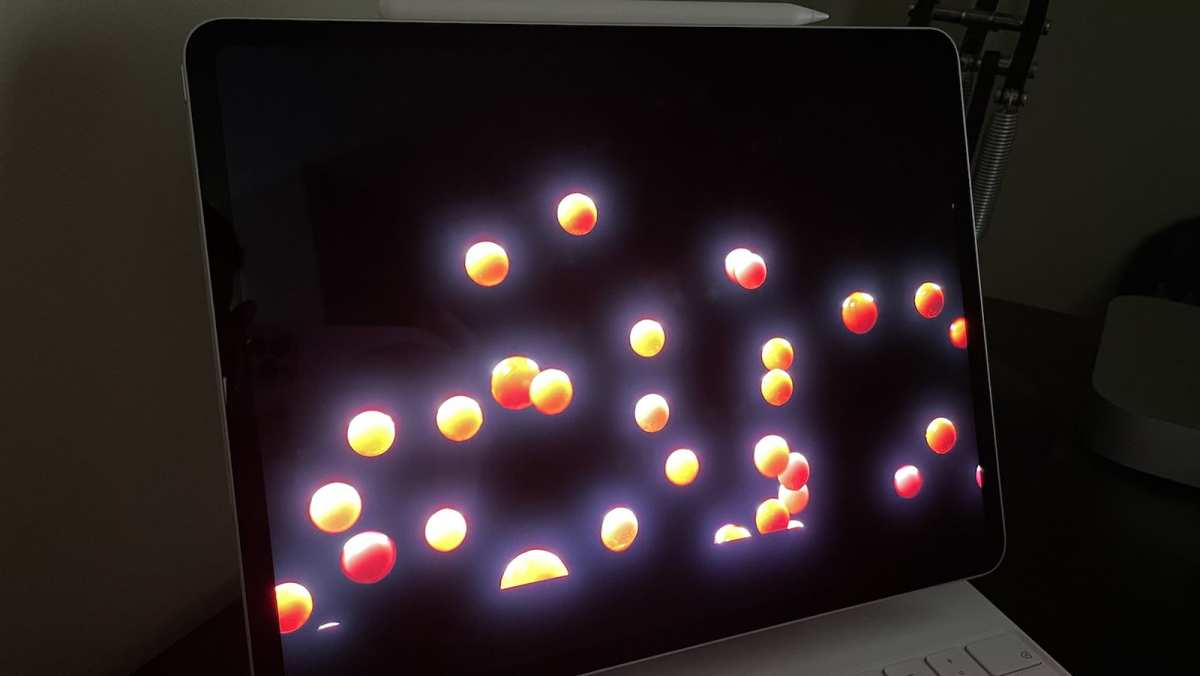
Blooming is the most common complaint with Mini LED displays. When a bright object appears against a dark background, light from the dimming zone bleeds slightly into adjacent zones. This creates a faint halo or glow around the bright object.
White subtitles on a black screen are the most obvious example.
Better Mini LED implementations with more zones and smarter dimming algorithms reduce blooming significantly. But it's still visible on most models, especially in very dark scenes. OLED doesn't have this issue at all since each pixel is its own light source.
If you're sensitive to blooming, it's worth seeing a Mini LED TV in person before buying.
Thicker Panels
All those extra LED chips behind the panel add physical depth. Mini LED TVs are noticeably thicker than OLED displays, which can be just a few millimeters thin. Some Mini LED models are 25 to 40 millimeters thick or more.
If you're planning to wall-mount a TV and want it flush against the wall, that extra depth matters for the visual profile.
Quality Varies Wildly Between Models
Not all Mini LED TVs are created equal. A budget Mini LED with 50 to 100 dimming zones and a basic dimming algorithm can perform worse than a good standard FALD LCD. The technology is only as good as the implementation.
Premium Mini LED TVs from brands like Samsung, TCL, and Hisense with 1,000+ zones and well-tuned algorithms deliver excellent performance. But the entry-level end of the Mini LED market can be misleading. The name on the box doesn't guarantee a great picture.
You need to check the actual zone count and read reviews that specifically test local dimming performance.
Higher Power Consumption
More LEDs mean more power. A 65-inch Mini LED TV can consume 150 to 300 watts during normal use, compared to 80 to 150 watts for a similar-sized standard LED LCD. OLED is even more efficient for content with lots of black, since those pixels are essentially off.
Over years of use, the electricity cost difference adds up, though it's usually not dramatic enough to be a dealbreaker on its own.
Mini LED vs. Standard LCD vs. OLED: Side-by-Side Comparison
Now that we've covered how Mini LED works and where it shines, it helps to see how it stacks up directly against both standard LCD and OLED. Each technology has a clear sweet spot depending on your room, your content habits, and your budget.
| Feature | Standard LED LCD | Mini LED LCD | OLED |
|---|---|---|---|
| Backlight type | Edge-lit or basic FALD | Thousands of tiny LEDs | Self-emissive pixels |
| Dimming zones | 0 to ~200 | 500 to 2,500+ | Per pixel (millions) |
| Peak brightness | 300 to 600 nits | 1,000 to 4,000+ nits | 800 to 1,300 nits |
| Black levels | Grayish, limited | Very deep, near-OLED | Perfect, pixel-off |
| Burn-in risk | None | None | Yes, over time |
| Panel thickness | 15 to 40mm | 20 to 45mm | 3 to 8mm |
| Power consumption | Low to moderate | Moderate to high | Low to moderate |
| Price at 65 inches | $400 to $800 | $800 to $2,000 | $1,500 to $3,000+ |
| Best for | Budget viewing | Bright rooms, HDR, gaming | Dark rooms, cinephiles |
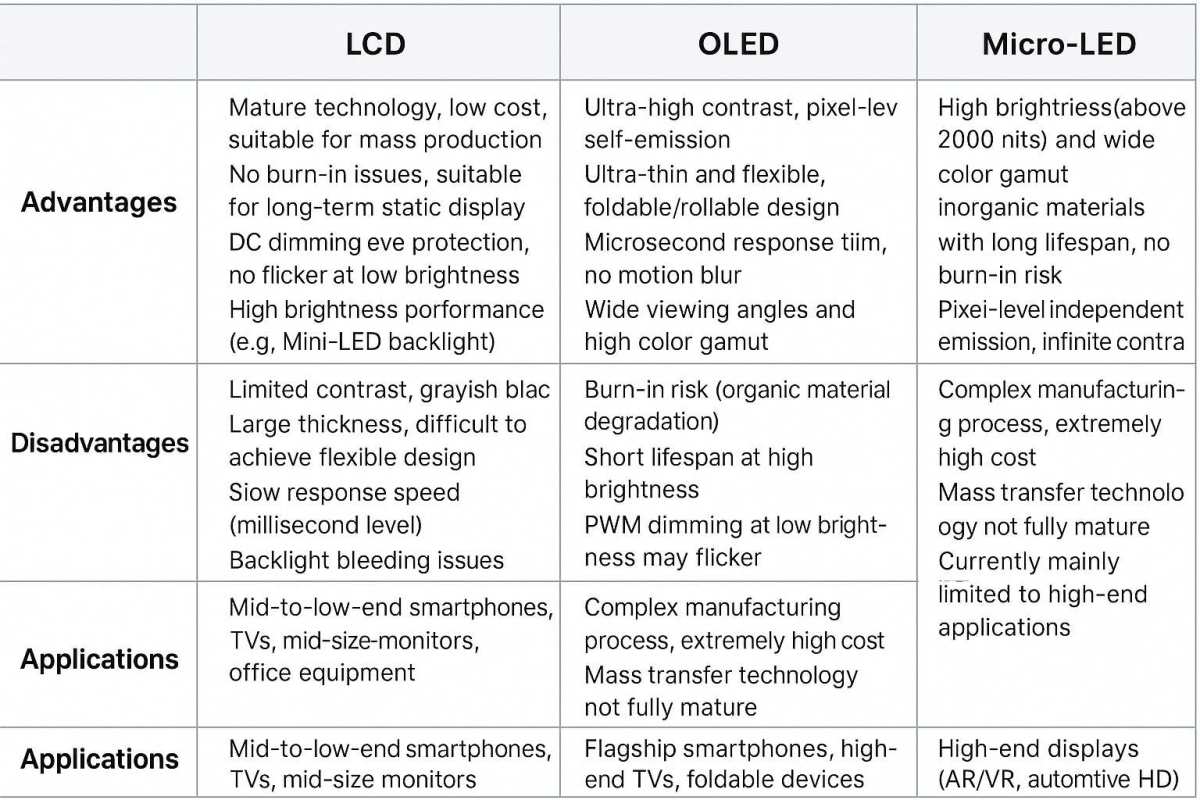
Standard LCD still has a place. If you're on a tight budget and mostly watch cable TV or casual content, a decent LED LCD looks perfectly fine. The jump to Mini LED is really about HDR performance, contrast, and future-proofing your setup for 4K HDR streaming and gaming.
OLED remains the king of dark-room viewing. Those perfect blacks and zero blooming are hard to beat when the lights are off. But Mini LED closes the gap significantly while winning on brightness, longevity, and price at larger sizes.
For most living rooms with ambient light, Mini LED is the more practical choice in 2025.
Who Should Choose Mini LED Over Standard LCD
Not everyone needs Mini LED. But there are specific situations where it's a meaningful upgrade over a standard LCD and worth the extra cost.
Bright Living Rooms and Sunlit Spaces
If your TV sits across from a big window or you watch a lot of content during the day with the lights on, Mini LED's high brightness is a game changer. Standard LCDs look washed out in those conditions. Mini LED maintains punchy colors and strong contrast even when ambient light is competing.
Gamers Worried About Burn-In
If you play games with static health bars, minimaps, or score overlays for hours every day, OLED burn-in is a real concern over time. Mini LED gives you excellent HDR gaming performance with zero risk of permanent image retention. That peace of mind alone is worth the upgrade for heavy gamers.
Home Theater Fans Who Want OLED Quality Without OLED Price
A 65-inch Mini LED TV delivers impressive HDR performance for roughly half the price of a comparable OLED. If you want a cinematic experience but your budget doesn't stretch to OLED, Mini LED is the best middle ground available right now.
Anyone Keeping a TV for 7+ Years
LED backlights last a long time. Manufacturer specs rate Mini LED backlights at 60,000 to 100,000 hours before reaching half brightness. That's well over a decade of typical use.
If you're the type who buys a TV and sticks with it for years, Mini LED avoids the OLED degradation question entirely.
Professional and Creative Work
Video editors and colorists working in HDR need a display that can hit high brightness targets and cover wide color gamuts like DCI-P3 and Rec. 2020. Mini LED monitors and TVs from brands like Apple (Pro Display XDR) and ASUS (ProArt series) are designed for this. They offer the brightness and color volume that standard LCDs simply can't match.
What to Check Before You Buy a Mini LED TV
Buying a Mini LED TV isn't as simple as picking the cheapest model with the label on the box. Here's what actually matters when you're comparing options.
Dimming Zone Count
This is the single most important spec. More zones mean finer control over brightness and less blooming. As a general guide:
- Under 200 zones: Entry-level Mini LED. Improvement over standard LCD but blooming will still be visible.
- 500 to 1,000 zones: Mid-range. Good HDR performance with manageable blooming in most content.
- 1,000 to 2,500+ zones: Premium. Excellent contrast and minimal blooming. This is where Mini LED really earns its name.
Manufacturer marketing doesn't always highlight zone counts prominently. You may need to check detailed spec sheets or third-party reviews to find the actual number for a specific model.
Panel Type Matters Too
Mini LED is a backlight technology, not a panel technology. The LCD panel itself can be VA, IPS, or ADS (a variant of IPS). Each has trade-offs:
- VA panels offer the highest native contrast, which pairs well with Mini LED's local dimming. Colors shift more at off-angles though.
- IPS panels have wider viewing angles but lower native contrast. Mini LED compensates for this somewhat with its dimming zones.
- ADS panels are a compromise between the two, used by some Chinese manufacturers like Hisense and TCL.
A Mini LED backlight on a VA panel generally delivers the best overall picture quality. But if you need wide seating arrangements where people watch from the sides, an IPS-based Mini LED might serve you better.
Peak Brightness Numbers
Check the sustained peak brightness, not just the momentary peak. Some displays can flash a small area at 4,000 nits for a split second but can't sustain that brightness across a large area of the screen. Look for reviews that measure full-screen sustained brightness, which is what you'll actually experience during normal viewing.
Dimming Algorithm Quality
Two TVs with the same number of zones can look very different. The software that decides how bright each zone should be at any given moment matters enormously. A well-tuned algorithm on a 500-zone display can outperform a poorly tuned one on a 1,500-zone display.
This is where brand reputation and independent review testing become essential.
Common Mistakes People Make When Shopping for Mini LED
Buyers often focus on the wrong things or skip important checks. Here are the most common pitfalls to avoid.
Assuming all Mini LED is the same. A budget 55-inch Mini LED with 80 zones is not the same experience as a flagship 75-inch with 2,000 zones. The technology scales dramatically with implementation quality. Always check the zone count and read local dimming tests before buying.
Ignoring room lighting conditions. If your room is always dark, OLED will still look better in many scenarios. Mini LED's advantages are most visible in rooms with some ambient light. Match the technology to your actual viewing environment, not just the spec sheet.
Overlooking the panel type. As we covered above, VA, IPS, and ADS panels behave differently. A Mini LED backlight can't fully compensate for an IPS panel's low native contrast. Know what panel type you're getting and factor that into your decision.
Chasing the highest brightness number. A spec sheet claiming 4,000 nits peak brightness sounds impressive. But if the dimming algorithm is poor or the zone count is low, the real-world picture quality won't match the number. Sustained brightness and zone count matter more than peak flash brightness.
Not checking firmware update history. Some Mini LED TVs have received firmware updates that significantly improved local dimming performance after launch. A model that got great reviews at launch might have gotten even better since. Conversely, some updates have introduced bugs.
Check recent user feedback before committing.
Real-World Pricing and What to Expect in 2025
Mini LED pricing has dropped significantly since the technology first hit the consumer market. Chinese manufacturers like TCL and Hisense have been particularly aggressive, pushing premium Mini LED features into mid-range price points.
As of 2025, here's a rough pricing breakdown by size and tier:
| Size | Budget Mini LED | Mid-Range Mini LED | Premium Mini LED |
|---|---|---|---|
| 55 inches | $500 to $700 | $700 to $1,200 | $1,200 to $2,000 |
| 65 inches | $600 to $900 | $900 to $1,800 | $1,800 to $3,000 |
| 75 inches | $800 to $1,300 | $1,300 to $2,500 | $2,500 to $4,000 |
| 85 inches | $1,200 to $2,000 | $2,000 to $3,500 | $3,500 to $6,000+ |
These ranges shift throughout the year, especially during Black Friday and other sales events. The mid-range tier is where most buyers get the best value. You get a high zone count, good brightness, and solid dimming algorithms without paying flagship premiums.
Premium models from Samsung's Neo QLED line and TCL's flagship series offer the best overall performance. But the gap between mid-range and premium has narrowed. Unless you're a serious home theater enthusiast, a well-chosen mid-range Mini LED will serve you extremely well.
Frequently Asked Questions
Is Mini LED better than standard LCD?
Yes, in almost every picture quality metric. Mini LED offers deeper blacks, higher peak brightness, better HDR performance, and improved contrast. The only trade-offs are slightly higher power consumption and a thicker panel profile.
Can Mini LED match OLED picture quality?
In bright rooms, Mini LED often looks better due to its higher peak brightness. In dark rooms, OLED still wins on black levels and blooming control. Mini LED gets close though, especially premium models with 1,000+ zones.
Does Mini LED have burn-in?
No. Mini LED uses an inorganic LED backlight and a standard LCD panel. Neither component suffers from burn-in.
This is a genuine advantage over OLED for static content like news channels and game HUDs.
How many dimming zones do I actually need?
For a noticeable improvement over standard LCD, look for at least 300 to 500 zones on a 65-inch display. For excellent performance with minimal blooming, aim for 1,000 or more zones. The sweet spot for most buyers in 2025 is the 500 to 1,500 zone range.
Is Mini LED worth the extra cost over standard LCD?
If you watch HDR content, game on a modern console, or have a bright room, the upgrade is absolutely worth it. If you mostly watch standard-definition or 1080p SDR content in a dim room, a standard LCD still looks fine and saves you money.
What is the lifespan of a Mini LED TV?
Manufacturer specifications rate Mini LED backlights at 60,000 to 100,000 hours before reaching half brightness. At 6 hours of daily use, that translates to roughly 27 to 45 years. The backlight will likely outlast the TV's processing hardware and smart TV software support.
Final Verdict: Is Mini LED Worth the Upgrade Over Standard LCD?
For most people shopping for a TV or monitor in 2025, Mini LED is the smart upgrade over standard LCD. You get dramatically better contrast, much brighter HDR highlights, and no burn-in risk. The price premium over basic LCD has shrunk to the point where it's hard to justify skipping it.
Standard LED LCD still makes sense if you're on a very tight budget or buying a secondary display for a bedroom or guest room where picture quality isn't a priority. There's nothing wrong with a good basic LCD for casual viewing.
But if you're buying a primary display and you want it to look great with modern 4K HDR content, Mini LED hits the sweet spot. It delivers near-OLED picture quality at lower prices, handles bright rooms better, and won't develop burn-in over time. That combination of performance, durability, and value is what makes Mini LED the display technology to beat right now.

Similar Posts