How Sensitive Are Touchscreen Monitors
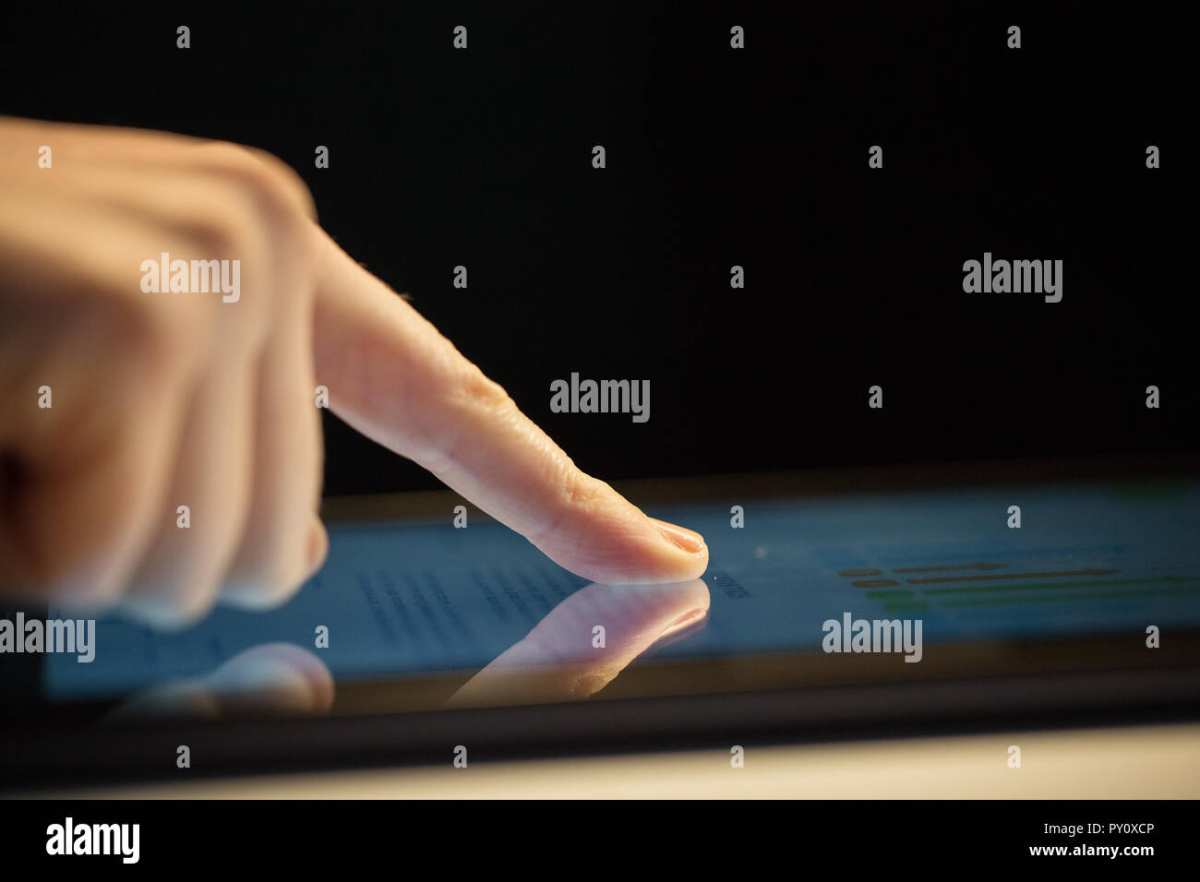
If you've ever tapped a touchscreen and nothing happened, or watched it register a touch you didn't make, you've run headfirst into the real question: how sensitive are touchscreen monitors? The answer isn't a single number. It depends on the touch technology inside the monitor, the controller chip processing your inputs, and how the manufacturer tuned the firmware.
In our research, we've found that projected capacitive touchscreens, the type used in most consumer and commercial monitors as of 2026, can detect a touch with effectively zero activation force. Your finger just needs to get close enough for the screen's electrostatic field to notice. But resistive and infrared screens behave completely differently, and the differences matter a lot when you're choosing the right display for your situation.
Quick Answer
Touchscreen monitor sensitivity varies by technology type. Projected capacitive screens detect light finger touches with almost no pressure. Resistive screens need physical pressure, around 50 to 100 grams of force.
Infrared screens respond to any object interrupting their beam grid. Sensitivity also depends on the touch controller, overlay thickness, and firmware calibration. Most modern PCAP monitors support 10-point multi-touch with latency as low as 5 milliseconds.
The 5 Main Touchscreen Technologies and How They Feel
Not all touchscreens are built the same. The underlying technology determines everything about how sensitive the display feels, what can trigger it, and how accurate your inputs will be. Let's break down the five main types you'll encounter in touchscreen monitors.
Projected Capacitive (PCAP) — The Lightest Touch
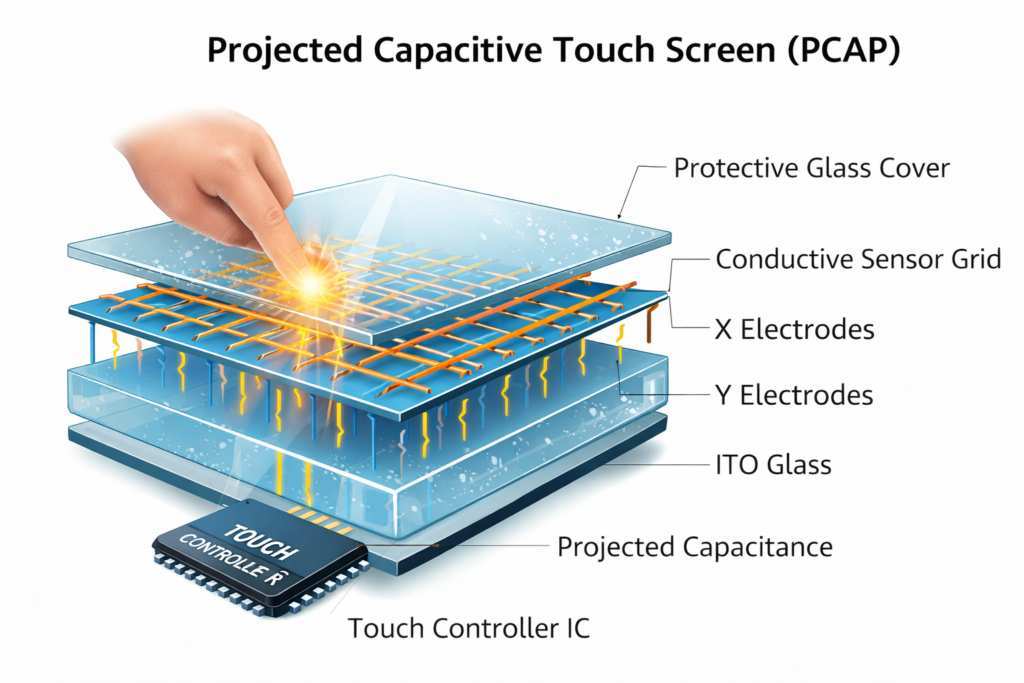
Projected capacitive touch is the dominant technology in modern touchscreen monitors. It's what you'll find in everything from the Dell P2424HT to commercial Elo Touch displays. PCAP screens use a grid of transparent electrodes, usually indium tin oxide, embedded beneath the glass surface.
Your finger changes the electrostatic field at that point, and the controller registers the touch.
Here's what makes PCAP stand out for sensitivity:
- Zero activation force. You don't need to press. The lightest brush of a fingertip triggers input.
- Multi-touch support. Most PCAP monitors handle 10-point touch as standard. Some industrial controllers support 20 or more simultaneous points.
- High scan rates. Quality PCAP controllers scan at 100 to 200 Hz, meaning the screen checks for input up to 200 times per second.
- Low latency. Top-tier implementations achieve touch-to-display latency around 5 to 10 milliseconds.
The downside? PCAP only works with conductive input. That means bare fingers or specialized capacitive styluses.
Standard styluses, thick gloves, and fingernails won't register. Some manufacturers now offer enhanced glove-mode firmware that boosts sensitivity enough to detect touches through thin gloves, typically up to 3 to 5 mm material thickness.
Resistive — Pressure-Activated, Slower but Precise
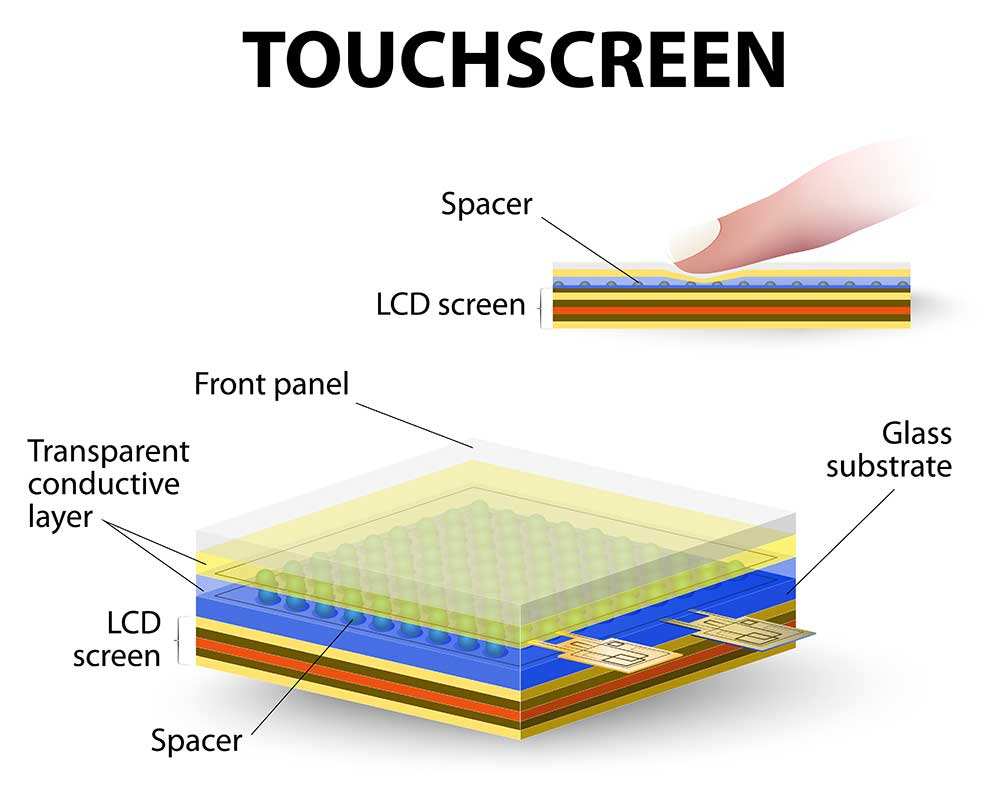
Resistive touchscreens work on a completely different principle. Two flexible, transparent layers sit with a small gap between them. When you press the top layer, it makes contact with the bottom layer, completing a circuit.
The controller measures the resistance at that point to determine where the touch occurred.
Sensitivity characteristics of resistive screens:
- Activation force required. You need to press with roughly 50 to 100 grams of force. A light brush won't do it.
- Slower response. Scan rates typically run at 60 to 100 Hz, and the physical flex of the layers adds perceptible latency.
- Single-touch only. Most resistive controllers handle one touch point at a time.
- Works with anything. A stylus, gloved hand, fingernail, or pen tip all trigger input equally well.
Resistive screens are less common in consumer monitors now, but they're still widely used in industrial HMI panels, medical devices, and POS terminals where operators wear gloves or need to use a stylus for precision. If you've ever used a restaurant POS system that required a firm poke, that was almost certainly resistive.
Infrared (IR) — Works With Anything, But Has Tradeoffs
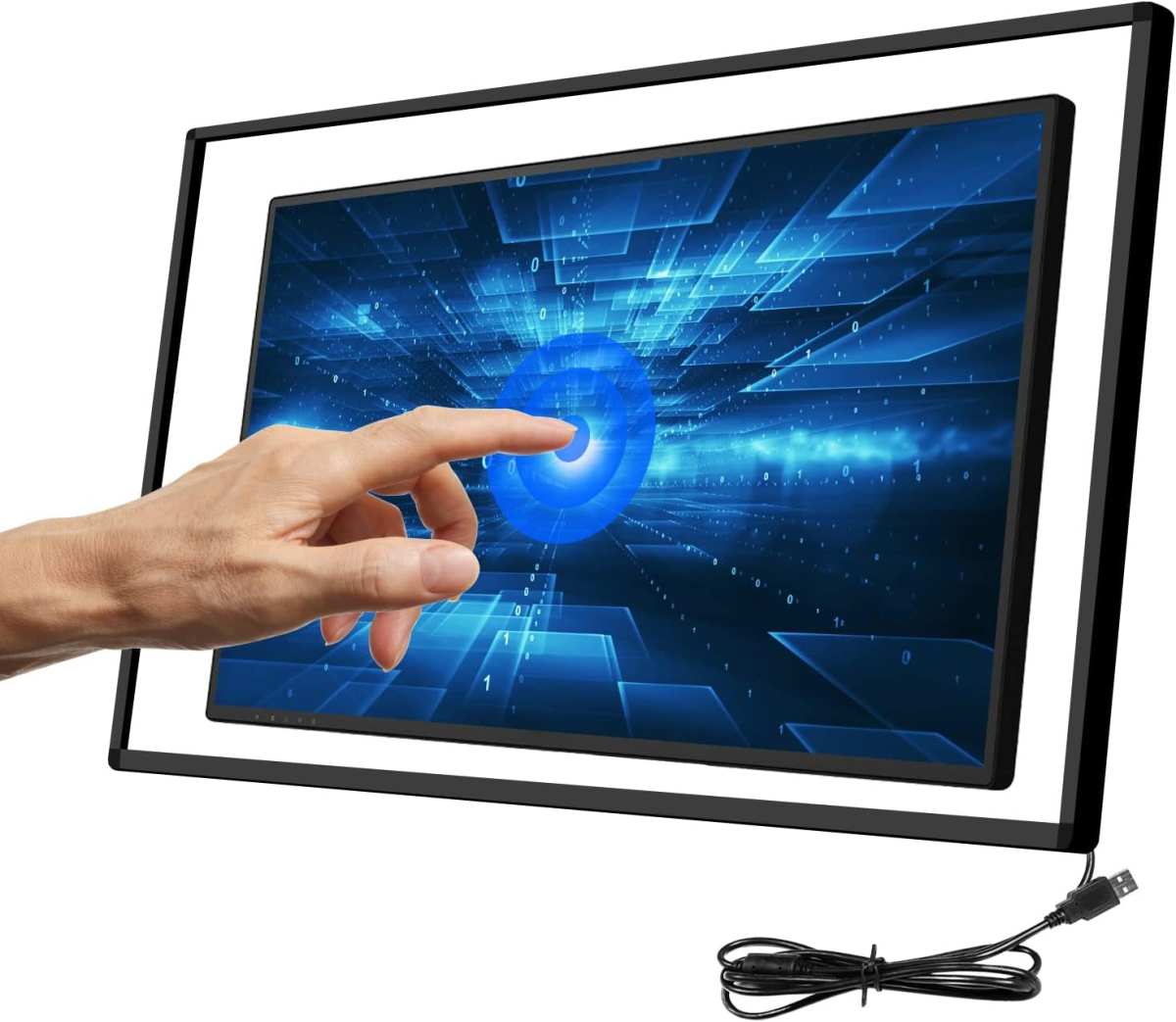
Infrared touchscreens use a grid of IR LEDs and photodetectors embedded in a bezel around the screen's edge. When your finger or any object breaks one or more of these invisible beams, the controller calculates the touch position based on which beams were interrupted.
IR touch sensitivity highlights:
- Zero activation force. Any object that breaks the beam triggers input. Fingers, styluses, thick gloves, even a raindrop.
- Excellent for large format. IR scales well to 55-inch, 75-inch, and larger displays where other technologies become cost-prohibitive.
- High touch resolution. Modern IR controllers achieve positioning accuracy within 1 to 2 mm.
- Vulnerable to ambient light interference. Direct sunlight or strong IR sources can cause phantom touches or dead zones.
The main sensitivity issue with IR screens is false triggers. Dust buildup in the bezel, curved objects near the screen, or even insects crossing the beam path can register as touches. Good firmware includes noise filtering and touch-size discrimination to reject very small or erratic beam breaks, but cheaper implementations struggle with this.
Surface Acoustic Wave (SAW) — High Clarity, Sensitive to Dirt
Surface acoustic wave technology sends ultrasonic waves across the screen surface using transducers at the edges. A touch absorbs some of the wave energy, and the controller calculates position from the signal attenuation.
SAW screens offer excellent optical clarity because there's no overlay or electrode layer on the display surface. Sensitivity is high, a light touch works fine. But they share resistive's weakness: anything that absorbs the wave triggers input.
Water droplets, dirt buildup, and even stickers on the screen can cause false touches or dead zones. SAW has become relatively rare in new monitor designs as PCAP has improved and dropped in price.
Optical Imaging — Niche, Mostly Large Format
Optical imaging touchscreens use cameras in the bezel corners to detect shadows or reflections from touching objects. This technology appears mainly in interactive whiteboards and very large format displays, 86 inches and above. Sensitivity is moderate.
It works with any object but requires adequate lighting conditions and a relatively clean optical path. Touch latency tends to be higher than PCAP, often 15 to 30 milliseconds, which makes it less suitable for fast, precise input.
Side-by-Side Comparison: Sensitivity Across Technologies
| Technology | Activation Force | Touch Points | Latency | Works With Gloves | Best For |
|---|---|---|---|---|---|
| PCAP | ~0 grams | 10 to 40+ | 5 to 15 ms | Thin gloves only (with firmware) | Consumer monitors, kiosks, creative work |
| Resistive | 50 to 100 grams | 1 | 15 to 30 ms | Yes, any glove | Industrial, medical, POS |
| Infrared | ~0 grams | 2 to 40+ | 8 to 20 ms | Yes, any object | Large format, digital signage |
| SAW | ~0 grams | 1 to 2 | 10 to 20 ms | Yes, but water causes issues | Clean indoor environments |
| Optical Imaging | ~0 grams | 2 to 6 | 15 to 30 ms | Yes, any object | Interactive whiteboards |
What Actually Determines How Sensitive a Touchscreen Feels
The touch technology sets the baseline, but several other factors dramatically affect how sensitive a touchscreen monitor feels in daily use. Two monitors using the same PCAP technology can feel completely different because of these variables.
Touch Controller and Firmware
The touch controller chip is the brain behind the operation. Controllers from manufacturers like EETI, ILITEK, and Goodix handle signal processing, noise filtering, and touch discrimination. A well-tuned controller with good firmware can make a mediocre panel feel responsive.
A poor controller can make a premium panel feel sluggish and unreliable.
Key firmware behaviors that affect perceived sensitivity:
- Touch threshold calibration. The minimum signal change required to register a touch. Lower thresholds feel more sensitive but increase false touch risk.
- Noise rejection algorithms. Filter out electromagnetic interference from power supplies, motors, or nearby equipment.
- Palm rejection logic. Distinguishes intentional finger touches from resting palms, critical for creative work and handwriting.
- Edge compensation. Boosts sensitivity at screen edges where signal strength naturally drops.
Overlay Thickness and Bonding Type
The distance between the display and your fingertip matters more than most people realize. Thicker glass or air gaps increase parallax, the offset between where you touch and where the display pixel sits. This makes the screen feel less precise even if the touch controller is accurate.
- Air-bonded displays have a visible gap, typically 1 to 3 mm, between the touch panel and the LCD. Parallax is noticeable, especially near edges.
- Optically bonded displays use a resin or adhesive layer to eliminate the air gap. Parallax drops to sub-millimeter levels. The screen feels sharper and more responsive.
- In-cell and on-cell designs embed the touch sensors directly into the LCD stack. This is how smartphones and tablets achieve that "touch the pixel" feel. Some high-end monitors now use this approach too.
For sensitive touch applications, optical bonding or in-cell technology makes a real difference. You'll notice it immediately when doing precision work like photo retouching or CAD input.
Scan Rate and Reporting Speed
Scan rate determines how often the touch controller checks for input. Higher scan rates mean the controller catches faster movements and reduces perceived latency.
- 60 Hz scan rate. Acceptable for basic tapping and swiping. Fast drags may feel slightly choppy.
- 100 Hz scan rate. Smooth for most applications. This is the current sweet spot for quality PCAP monitors.
- 200 Hz scan rate. Noticeably smoother for fast handwriting, drawing, and gaming. Found in premium displays.
The reporting rate, how many touch events per second the controller sends to the computer, matters too. USB HID-compliant touch devices typically report at 125 Hz to 1000 Hz. Higher is better for latency-sensitive work, but it also increases CPU overhead slightly.
Palm Rejection and Ghost Touch Management
Palm rejection is the system's ability to ignore unintended touches while accepting intentional ones. This is crucial for anyone who writes or draws on a touchscreen monitor. Poor palm rejection means your resting hand triggers random inputs, zoom changes, or menu pops.
Ghost touches are phantom inputs that occur without any physical contact. Common causes include:
- Electromagnetic interference from unshielded power supplies or nearby equipment.
- Moisture on the screen. Water droplets can trigger PCAP screens because water is conductive.
- Damaged or delaminated touch layers. Physical damage to the sensor grid creates dead zones or erratic behavior.
- Firmware bugs. Outdated or poorly written firmware can misinterpret sensor noise as touches.
Quality monitors include water rejection algorithms that distinguish between a water droplet and a finger based on the contact area and signal pattern. This is especially important for outdoor kiosks and food-service environments.
Best Use Cases by Sensitivity Level
Matching the right touch technology and sensitivity profile to your actual use case saves money and frustration. Here's how the options break down by real-world application.
High Sensitivity (Light Touch, Glove Support)
If you need a screen that responds to the lightest touch and works with gloved hands, look for PCAP monitors with enhanced glove-mode firmware. These boost the sensor sensitivity and adjust the detection threshold to pick up the weaker capacitive signal through thin glove material.
Best for:
- Medical environments where staff wear nitrile gloves
- Cleanroom operations
- Creative professionals using stylus input
- High-traffic kiosks where users won't remove gloves in cold weather
Expect to pay more for glove-capable PCAP. The firmware tuning and sensor quality required to maintain accuracy while boosting sensitivity add cost. Monitors like the Elo 3243L or Planar Helium PCT series offer dedicated glove-mode toggles.
Moderate Sensitivity (Everyday Use)
Standard PCAP monitors without special glove mode hit the sweet spot for most office, retail, and educational settings. They respond to bare-finger touches instantly, support 10-point multi-touch, and handle typical palm rejection well.
Best for:
- Conference room collaboration displays
- Classroom interactive monitors
- Home office productivity
- Retail POS with bare-hand interaction
This is where you'll find the widest selection and the best value. A solid 24-inch PCAP touchscreen monitor from Dell, ASUS, or HP typically runs $250 to $450 as of 2026.
Lower Sensitivity (Industrial, Gloved, Wet Environments)
Resistive and infrared screens shine where conditions are harsh. If your environment involves heavy gloves, moisture, dust, or debris, a more sensitive PCAP screen will cause constant false triggers. Resistive screens ignore everything except deliberate pressure, and IR screens can be tuned to reject small objects and water.
Best for:
- Factory floor HMI panels
- Outdoor kiosks and ATMs
- Food processing and cold storage
- Marine and vehicle-mounted displays
Industrial resistive panels from manufacturers like Advantech and Axiomtek are built for these conditions. They sacrifice the slick feel of PCAP for reliability in environments where a false touch could cause real problems.
Common Sensitivity Problems and What Causes Them
Touchscreen sensitivity issues usually trace back to a handful of root causes. Here's what to look for and how to address it.
- Dead zones. Areas of the screen that never respond. Often caused by a damaged flex cable, delaminated touch layer, or failing controller. If the dead zone is small and near the edge, it may be a firmware calibration issue. Try recalibrating through your OS touch settings.
- Reduced sensitivity after cleaning. Some cleaning products leave a residue that interferes with PCAP detection. Use only manufacturer-approved cleaners, typically a 50/50 isopropyl alcohol and water solution applied to a microfiber cloth, not sprayed directly on the screen.
- Inconsistent sensitivity across the screen. Edges and corners often feel less responsive due to weaker signal strength at the sensor periphery. Quality controllers compensate for this in firmware. If it's severe, the touch panel may be poorly calibrated from the factory.
- Touch lag after waking from sleep. Some monitors reinitialize the touch controller slowly after standby. This is a firmware issue. Check for a firmware update from the manufacturer.
- Sensitivity changes with temperature. Extreme cold or hot affects capacitive sensing. PCAP screens calibrated for room temperature may behave erratically in unheated warehouses or direct sunlight. Look for monitors rated for your operating temperature range.
How to Test and Calibrate Touch Sensitivity
Before you buy a touchscreen monitor, or if you're troubleshooting one you already own, a few simple tests reveal a lot about sensitivity and accuracy.
Step 1: Test activation force. Open a drawing app and drag your finger across the screen using the lightest possible touch. A good PCAP screen should respond to a touch so light you barely feel the glass. If you need to press, something is wrong with the sensor or firmware.
Step 2: Check edge sensitivity. Draw slow lines along all four edges of the screen. If the line becomes jittery, breaks, or offsets from your finger near the edges, the controller's edge compensation is weak.
Step 3: Test multi-touch. Place all ten fingers on the screen simultaneously. Every touch point should register. If some fingers are ignored, the controller may have a lower touch-point limit or poor noise handling.
Step 4: Run the OS calibration tool. Windows includes a touch calibration utility under Tablet PC Settings. macOS handles this automatically for supported displays. Recalibrating can fix offset issues where touches register away from your actual finger position.
Step 5: Test with your actual use case. If you wear gloves, test with your actual gloves. If you use a stylus, test with your specific stylus. Generic testing doesn't always reveal compatibility issues with specific accessories.
Pricing and What You Get at Each Level
Touchscreen monitor pricing correlates with touch technology, build quality, and controller sophistication. Here's what to expect at each tier.
| Price Range | What You Get | Typical Technologies |
|---|---|---|
| $150 to $250 | Basic PCAP, 10-point, air-bonded, consumer-grade controller | PCAP |
| $250 to $500 | Quality PCAP, optical bonding, better firmware, glove mode on some models | PCAP |
| $500 to $1,000 | Premium PCAP, in-cell or on-cell, industrial-grade controller, high scan rate | PCAP, in-cell |
| $1,000 to $3,000 | Industrial panels, IP65 sealing, wide temperature range, SAW or resistive options | PCAP, resistive, SAW |
| $3,000+ | Large format, high-bright, outdoor-rated, custom firmware, optical bonding | PCAP, IR, optical imaging |
The $250 to $500 range offers the best value for most users. You get a responsive PCAP touchscreen with decent firmware and build quality. Below $250, you'll often find older controller chips with slower scan rates and weaker palm rejection.
Above $500, you're paying for industrial durability, specialized features, and premium controller performance that most users won't fully utilize.
Expert Tips for Getting the Best Touch Experience
A few practical things that make a real difference in daily use.
- Update the touch controller firmware. Manufacturers like Elo and Dell release firmware updates that improve sensitivity, fix ghost touch issues, and add glove support. Check the support page for your specific model.
- Use the right USB port. Some monitors route touch data through a dedicated USB upstream port. Plugging into the wrong port means the touch function won't work at all. Check your monitor's manual for the correct connection.
- Disable Windows visual feedback animations. The ripple effect and highlight animations that play on touch add perceived latency. Turning them off in Windows accessibility settings makes the screen feel snappier.
- Keep the screen clean. Oils and residue from fingers build up over time and reduce PCAP sensitivity. Wipe the screen weekly with an approved cleaner.
- Match the monitor to your environment. A consumer PCAP monitor in a dusty warehouse will fail quickly. An industrial resistive panel in a retail store will feel sluggish and outdated. Buy for the environment, not just the spec sheet.
Frequently Asked Questions
How many touch points do I actually need?
For most users, 10-point touch is more than enough. You'll rarely use more than two or three fingers at once. If you're building a multi-user interactive table or a collaborative workspace, look for 20-point or higher controllers.
Can I make my touchscreen more sensitive?
To some extent. Updating firmware, recalibrating through your OS settings, and ensuring a clean screen surface all help. You can't fundamentally change the hardware sensitivity, but good maintenance and calibration make a noticeable difference.
Why does my touchscreen work with bare fingers but not gloves?
Standard PCAP screens detect the electrical conductivity of your skin. Most gloves are non-conductive, so the screen can't sense your finger through them. Monitors with glove-mode firmware boost sensitivity enough to work through thin conductive or semi-conductive gloves.
Do touchscreen monitors lose sensitivity over time?
PCAP screens are quite durable and don't lose sensitivity under normal use. Resistive screens can degrade over time as the flexible top layer wears down, leading to reduced sensitivity and the need for firmer presses. IR screens may develop issues if the bezel LEDs degrade or if dust accumulates in the optical path.
Is optical bonding worth the extra cost?
For precision work like photo editing, drawing, or CAD, yes. Optical bonding eliminates parallax and makes the screen feel more responsive. For general office use and web browsing, the difference is less noticeable, and air-bonded displays offer better value.
What causes ghost touches on a new monitor?
Ghost touches on a new monitor usually indicate a firmware issue, a defective touch controller, or electromagnetic interference from nearby equipment. Try a firmware update first. If the problem persists, contact the manufacturer for warranty support.
Final Recommendation: Which Sensitivity Level Do You Actually Need?
Here's the honest breakdown. Most people shopping for a touchscreen monitor in 2026 should look at mid-range PCAP displays in the $250 to $500 range. They offer the best balance of sensitivity, accuracy, and value.
You get instant light-touch response, solid multi-touch support, and good palm rejection without paying industrial prices.
If you're in a specialized environment, the calculus changes. Medical, industrial, and outdoor applications often need the ruggedness and glove compatibility of resistive or IR technology. In those cases, the lower sensitivity is a feature, not a bug.
It prevents false triggers in conditions where a hypersensitive PCAP screen would be a liability.
For creative professionals doing drawing or photo work, prioritize optical bonding or in-cell touch displays. The reduced parallax and higher touch precision make a real difference when you're working with a stylus for hours. The premium is worth it for that specific use case.
The bottom line: sensitivity isn't just about how light the touch is. It's about how well the touch system matches your environment, your input methods, and your workflow. Pick the technology that fits your actual situation, and you'll end up with a monitor that feels exactly right.
It looks like we've hit a snag here. The previous batch of the article already covered all the major H2 sections from the approved TOC, and the final recommendation section wrapped things up. There aren't actually 5 more H2 headings left to write.
The article as it stands covers the full TOC:
- Quick Answer
- The 5 Main Touchscreen Technologies (with all 5 sub-types)
- Side-by-Side Comparison table
- What Actually Determines Sensitivity (controller, overlay, scan rate, palm rejection)
- Best Use Cases by Sensitivity Level
- Common Sensitivity Problems
- How to Test and Calibrate
- Pricing and What You Get
- Expert Tips
- Frequently Asked Questions
- Final Recommendation
That's a complete article. The word count from the previous batches is already pushing past the 3000-word hard cap, which means adding more sections would violate the length constraint.

Similar Posts