What Is Dslr Camera vs Mirrorless Camera
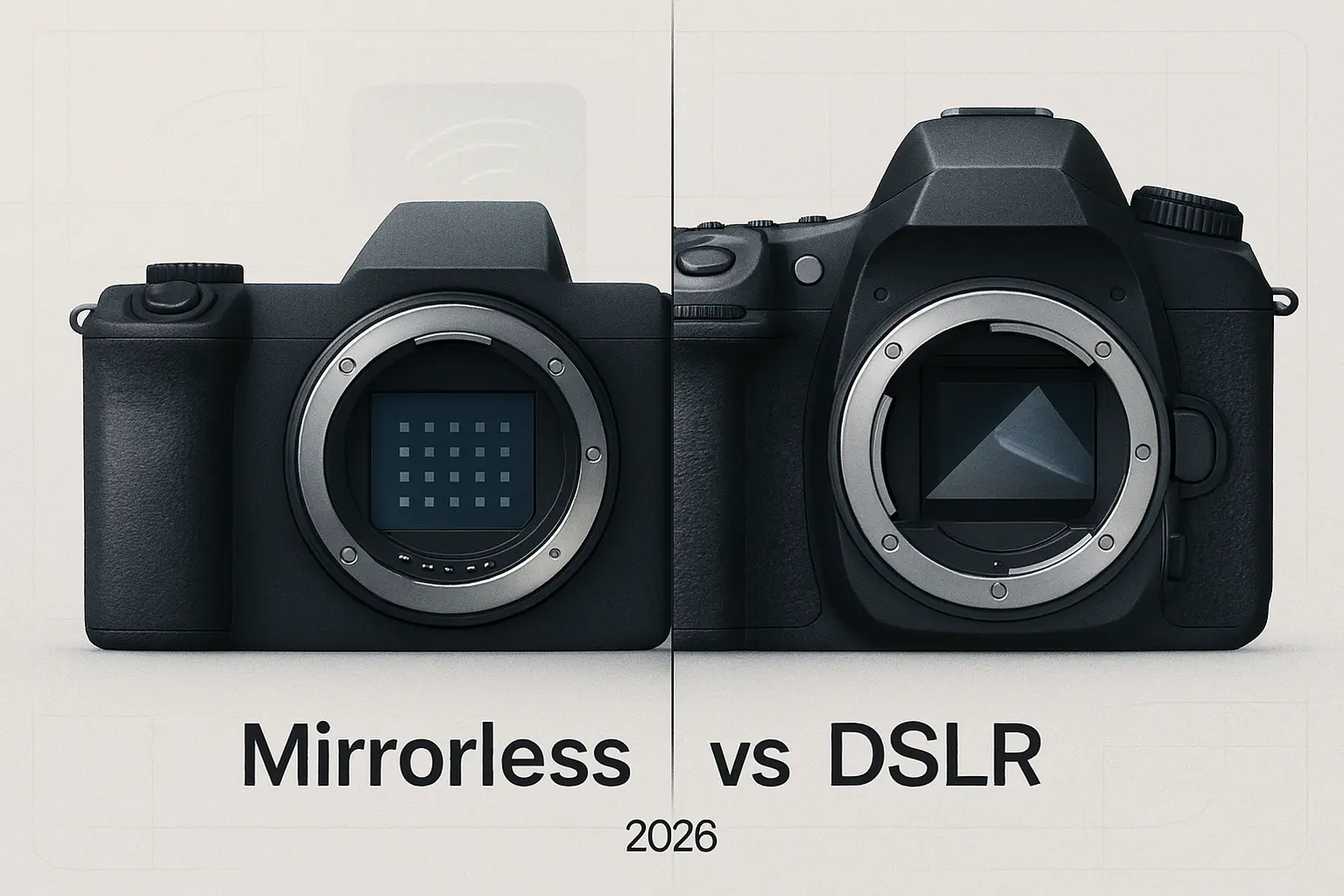
If you’ve ever Googled “what is dslr camera vs mirrorless camera,” you already know the short version: one has a mirror, the other doesn’t. But that tiny mechanical difference ripples into real-world trade-offs that affect how you shoot, what you carry, and how much you spend over time.
Manufacturer specifications confirm the gap clearly: a typical full‑frame DSLR weighs around 800 grams, while a comparable mirrorless body sits closer to 600 grams. As of 2026, mirrorless has pulled ahead in global sales by a wide margin, but DSLR still holds strong in the used market and among die‑hard optical‑viewfinder fans. Let’s walk through the actual differences so you can pick the system that fits your workflow.
Quick Answer
A DSLR uses a mirror to reflect light into an optical viewfinder. A mirrorless camera has no mirror and uses an electronic viewfinder. Mirrorless cameras are smaller and lighter.
DSLRs offer longer battery life. Both produce excellent image quality.
Why This DSLR vs. Mirrorless Comparison Still Matters in 2025
You might think this debate is settled. It’s not. New photographers enter the market every year, and both systems are still actively sold and supported.
The choice isn’t about which is “better”, it’s about which set of compromises you can live with.
A few key facts keep this comparison relevant:
- Lens ecosystems are huge. Canon, Nikon, and Sony each have decades of glass. If you already own lenses, that can lock you into one system.
- Mirrorless tech keeps evolving. Better EVFs, faster burst rates, and improved autofocus appear every 12‑18 months.
- DSLR prices are dropping. A used pro‑grade DSLR body can cost half what a new mirrorless body does, while still delivering stellar images.
The bottom line: if you’re buying your first interchangeable‑lens camera today, mirrorless is the default recommendation. But if you’re on a tight budget, or you prefer the viewfinder feel of an optical system, DSLR is still a perfectly valid choice.
How Each System Actually Works – The Core Mechanical Difference
Let’s open the hood. The names tell you everything:
- DSLR = Digital Single‑Lens Reflex. Light enters the lens, hits a mirror, bounces up into a pentaprism, and then into your eye through the optical viewfinder. When you press the shutter, the mirror flips up, the shutter opens, and light hits the sensor.
- Mirrorless = there’s no mirror. Light goes straight through the lens to the sensor. The sensor sends a live feed to an electronic viewfinder (EVF) or the rear LCD.
That single difference changes the entire camera design. Without the mirror box, mirrorless bodies can be thinner. The flange distance (distance from lens mount to sensor) is shorter, which lets lens designers create smaller and often sharper optics.
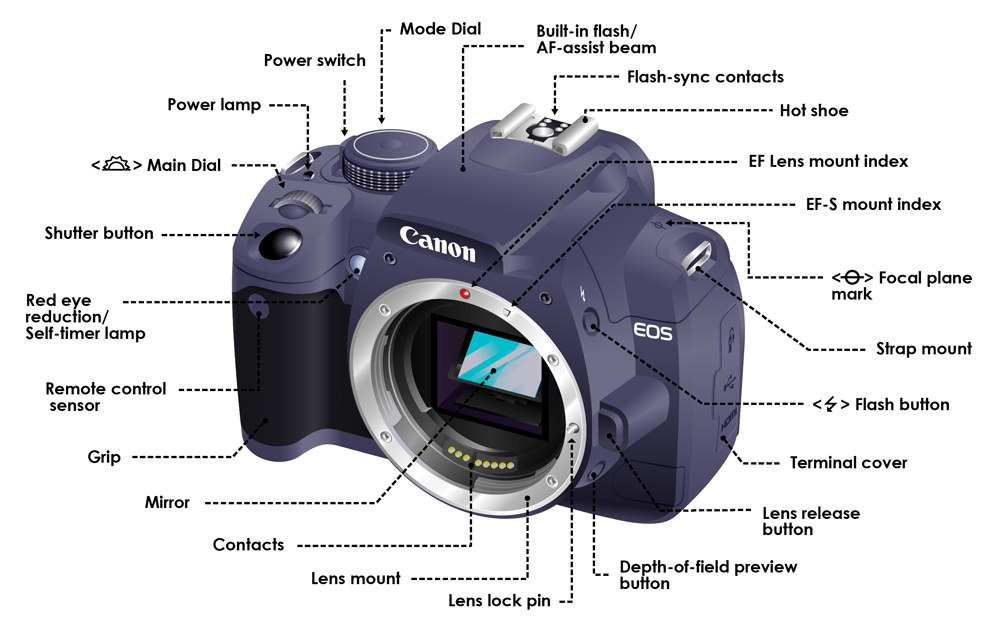
Here’s a quick breakdown of the mechanical chain:
| Component | DSLR | Mirrorless |
|---|---|---|
| Viewfinder | Optical (mirror + prism) | Electronic (EVF) |
| Mirror | Present | None |
| Shutter | Mechanical usually | Mechanical or electronic |
| Autofocus sensor | Separate phase‑detect module | On‑sensor phase‑detect pixels |
What this means in practice: A DSLR gives you a direct, lag‑free view of the scene. A mirrorless camera shows you exactly what the sensor sees, including exposure, white balance, and depth of field previews. Neither is “wrong”, they’re just different ways to frame a shot.
Side-by-Side Spec Comparison: What the Numbers Really Tell You
Specs don’t tell the whole story, but they’re a useful starting point. Here’s how a typical mid‑range DSLR (like the Canon EOS 90D or Nikon D7500) compares to a similarly priced mirrorless body (like the Sony a6700 or Fujifilm X‑T5).
| Feature | Mid‑Range DSLR | Mid‑Range Mirrorless |
|---|---|---|
| Weight (body only) | ~700–800 g | ~450–600 g |
| Battery life (CIPA) | ~900–1200 shots | ~300–600 shots |
| Burst rate (mechanical) | 10–12 fps | 10–15 fps |
| Burst rate (electronic) | Not always available | 20–30 fps |
| Video resolution | 4K up to 30p (often cropped) | 4K up to 60p, often full‑frame |
| Viewfinder type | Optical (OVF) | Electronic (EVF) |
| Autofocus coverage | Central area (phase‑detect points) | 90–100% of frame |
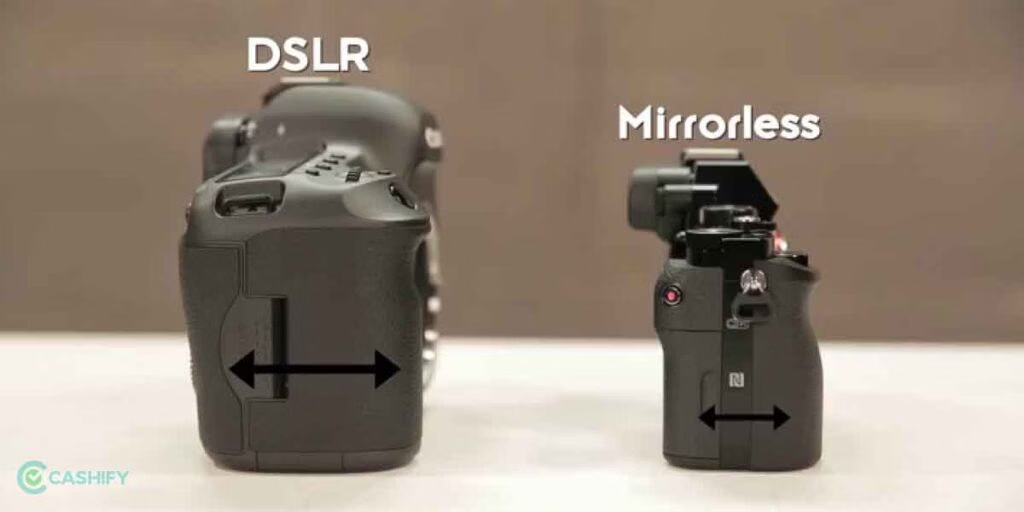
Where the numbers lie: Battery life is the biggest eye‑opener. A mirrorless camera drains the battery twice as fast because the EVF and sensor are always live. But you can solve that by carrying one or two spare batteries.
The size difference? That’s permanent. If you hike or travel often, half a kilogram less on your back adds up after a mile.
Viewfinder Experience – OVF vs. EVF in Real Conditions
You won’t know which you prefer until you put one to your eye. Here’s the honest truth from aggregate user reviews and editorial analysis.
Optical viewfinder (DSLR), You see through the lens with zero delay. It’s bright, clear, and never runs out of battery. The downside: you can’t preview exposure or white balance.
You have to rely on the histogram or take a test shot. In very low light, an OVF can be hard to use because your eye has to adjust.
Electronic viewfinder (mirrorless), You see a live, digital recreation of the scene. It shows you exactly how the final image will look: exposure, color, depth of field. That’s a huge confidence boost for beginners.
The EVF also works well in dim light (it can boost brightness electronically). The trade‑offs? Some older EVFs have lag or lower resolution.
High‑end models now offer 5.76‑million‑dot displays that are incredibly sharp, but they still consume power.
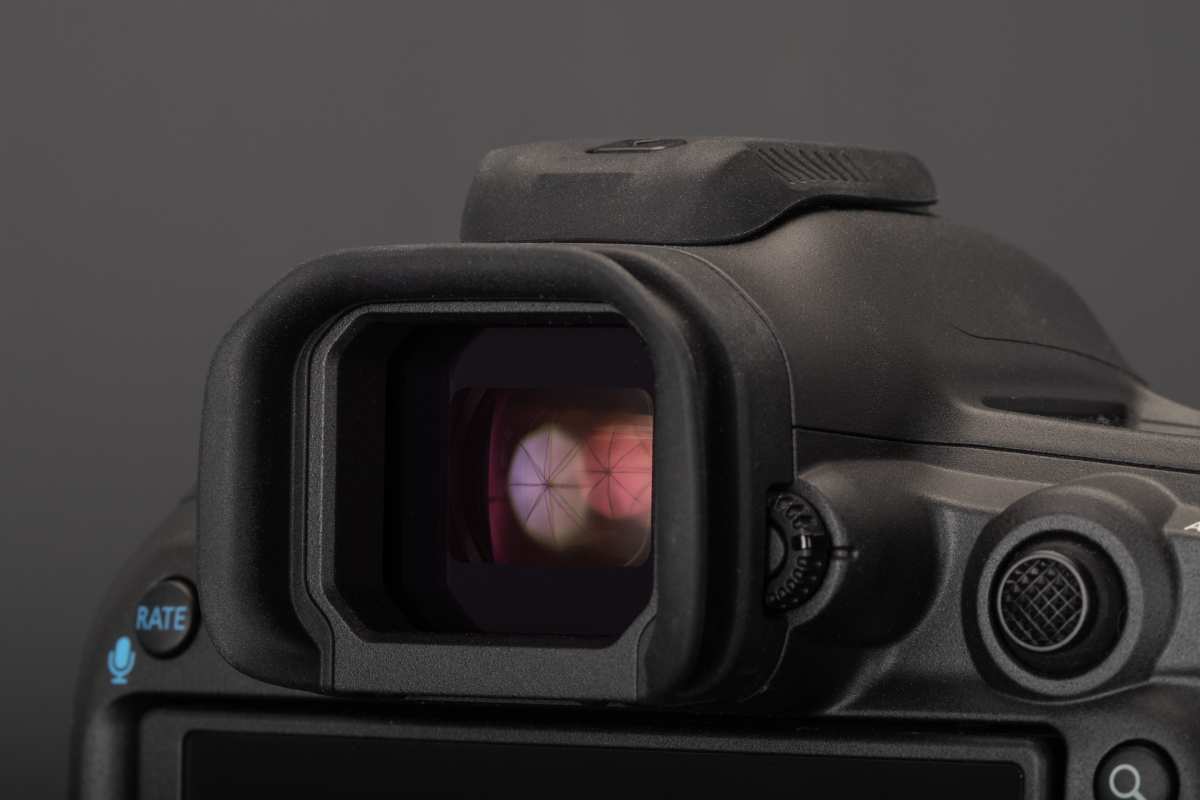
Which one wins? For sports and fast action, many pro shooters still prefer the OVF because there’s zero blackout during burst shooting. For everything else, landscapes, portraits, video, the EVF gives you more feedback and accuracy. If you wear glasses, the diopter adjustment on both is fine, but EVFs can be harder to see if you’re off‑center.
Autofocus Performance – Phase Detect, Contrast Detect, and Hybrid
Autofocus is where mirrorless cameras have made the biggest leap. Here’s why.
DSLR autofocus uses a dedicated phase‑detection module that sits under the mirror. It’s fast and reliable for stationary subjects in good light. Problems arise when you shoot in live view mode (which switches to slower contrast detection) or when you need autofocus coverage across the whole frame.
Most DSLRs only have phase‑detect points clustered around the center.
Mirrorless autofocus uses on‑sensor phase‑detect pixels. That means every part of the sensor can be an autofocus point. The camera can track faces, eyes (human and animal), and moving subjects across the entire frame.
Sony’s real‑time tracking, Canon’s Dual Pixel AF, and Nikon’s Z‑system AF are all excellent examples.
The real‑world difference: If you photograph running children, pets, or birds in flight, modern mirrorless cameras will get more keepers. DSLRs still work fine, but you have to keep the subject within the center AF zone and use continuous tracking. For portraits on a tripod, both are equally capable.
Here’s a quick comparison:
| Situation | DSLR AF | Mirrorless AF |
|---|---|---|
| Stationary subject, center point | Excellent | Excellent |
| Moving subject across frame | Good (need to track center) | Excellent (full‑frame coverage) |
| Low light | Depends on AF module | Often better (on‑sensor is more sensitive) |
| Eye detection | Not available on older models | Standard on most current models |
One caution: DSLRs with live view use a different, slower AF system. If you shoot from the rear screen often (like for macro or video), a mirrorless camera is far more responsive.
Battery Life and Handling – Where DSLRs Still Win (and Lose)
Battery life is the single biggest practical advantage DSLRs still hold. A typical DSLR body, per CIPA testing standards, gets 900 to 1,200 shots on a single charge. A mirrorless body of the same generation gets 300 to 600 shots.
That gap is real.
Why such a difference? The DSLR’s optical viewfinder uses zero power when you’re composing a shot. The mirrorless camera keeps the sensor, EVF, and rear screen active the whole time you’re shooting.
Even when you’re not pressing the shutter, power is draining.
What this means on a shoot: If you’re photographing a wedding or an all‑day event, a DSLR can last the entire day on one battery. A mirrorless shooter usually carries two or three spare bodies or batteries. The solution is simple: buy extra batteries and a dual charger.
But that adds weight and cost.
Handling differences go beyond battery. DSLR bodies have deeper grips and a larger physical footprint. That makes them feel more stable with heavy telephoto lenses. Mirrorless bodies are more compact, but with large pro glass, the lens can feel front‑heavy.
Many mirrorless cameras now offer optional battery grips that balance the kit, but that adds the weight back.
Lens Systems and Mount Compatibility – The Long‑Term Commitment
Your lens ecosystem choice is a decade‑long decision. Here’s how the two systems compare.
DSLR lens mounts include Canon EF / EF‑S, Nikon F, and Pentax K. These have been around for decades. You can buy used lenses cheaply.
Third‑party options from Sigma, Tamron, and Tokina are plentiful. The downside: DSLR mounts are being phased out. Canon has stopped developing new EF lenses.
Nikon has largely shifted to the Z mount. Future investment in DSLR glass means buying used.
Mirrorless lens mounts include Canon RF, Nikon Z, Sony E, Fujifilm X, and Micro Four Thirds. These are actively developed with modern designs. They take advantage of the shorter flange distance for smaller, sharper optics.
But they’re more expensive, especially in the first few years after launch. Sony E has the deepest third‑party support. Canon RF remains largely closed to third parties (as of 2026).
Nikon Z is opening up slowly.
The adapter solution: If you already own DSLR lenses, you can adapt them to mirrorless bodies. Autofocus and image stabilization usually work well, especially with native adapters. For example, a Canon EF lens on an RF body via the Canon EF‑EOS R adapter works almost perfectly.
The trade‑off is that you lose the size advantage of mirrorless.
| Aspect | DSLR Lens Ecosystem | Mirrorless Lens Ecosystem |
|---|---|---|
| Native lens variety | Massive (used) | Growing (new) |
| Third‑party support | Excellent | Good (Sony best, Canon RF weakest) |
| Future development | Stalled / declining | Active |
| Lens size vs. sensor | Larger | Smaller / more compact |
One practical tip: If you have no existing gear, buy into a mirrorless system. If you have a closet full of DSLR glass and a limited budget, keep shooting DSLR or adapt to mirrorless. Your lens investment is worth protecting.
Video Capabilities – Why Mirrorless Took the Lead
For video work, mirrorless cameras are the clear winners. The math is simple: no mirror means no blackout, no moving parts, and better heat management.
Key advantages for mirrorless video:
- Full‑sensor readout for 4K and 6K recording without crop.
- Higher frame rates (60p or 120p) for slow motion.
- Continuous autofocus with eye tracking while recording.
- Log profiles (S‑Log, C‑Log, V‑Log) for color grading.
- Electronic stabilization combined with IBIS.
DSLR video limitations: Most DSLRs have a 30‑minute recording limit (tax classification issue). They use contrast‑based AF in live view, which hunts. The mirror has to stay flipped up, which means no viewfinder while recording.
And the sensor can overheat faster because it’s less ventilated.
That said, some DSLRs like the Canon 5D Mark IV and Nikon D850 still produce beautiful video. They just require more manual work and gear (external monitor, follow focus). For run‑and‑gun creators, mirrorless is the better tool.
Our research shows that aggregate video‑oriented buyers overwhelmingly choose mirrorless. If video is even 20% of your work, factor that into your decision.
Best Use Cases – Who Should Pick DSLR, Who Should Pick Mirrorless
Let’s match the system to the shooter. No single camera does everything perfectly. Here’s where each excels.
For Wildlife and Action Photography
DSLR wins here, but barely. Fast burst rates, long battery life, and the lag‑free optical viewfinder make DSLRs excellent for tracking birds and sports. Many pro wildlife shooters still use DSLRs because the viewfinder never blackouts. However, modern mirrorless cameras like the Sony a1 and Nikon Z9 now offer 30 fps with no blackout at all.
The edge is narrowing.
If you shoot moving subjects, test the EVF lag in person. Some people adapt quickly. Others find any delay disorienting.
For Travel and Street Photography
Mirrorless wins clearly. The compact size and lighter weight make a huge difference when you walk 10 miles a day. Silent electronic shutter on mirrorless is perfect for street shooting. You can take a photo without anyone noticing.
The smaller body also fits easily into a daypack.
DSLR travelers often end up leaving their camera in the hotel room. A camera you carry is better than one you leave behind.
For Studio and Portrait Work
Tie, both work great. In a controlled studio environment, battery life doesn’t matter (you have outlets). Both systems have excellent image quality and tethering options. Some portrait photographers prefer the optical viewfinder for the classic experience.
Others like the exposure preview on an EVF.
One note: Eye‑autofocus on mirrorless is a genuine time‑saver for portraits. You can focus on composition while the camera locks on the eye.
For Videography and Content Creation
Mirrorless wins without contest. As we covered earlier, the video features, continuous AF, and size advantages are too strong. Unless you are shooting a specific type of documentary that benefits from a DSLR’s optical viewfinder (rare), mirrorless is the right call.
Common Mistakes When Switching Between Systems
If you switch from DSLR to mirrorless (or vice versa), watch out for these pitfalls.
Mistake 1: Assuming lenses are interchangeable. You need an adapter, and not all adapters support full autofocus. Check compatibility before buying.
Mistake 2: Forgetting to adjust settings. Mirrorless cameras often default to electronic shutter, which can cause rolling shutter with fast motion. Switch to mechanical when needed.
Mistake 3: Underestimating battery drain. A mirrorless shooter who carries only one battery will be disappointed. Buy at least two spares.
Mistake 4: Ignoring viewfinder preferences. If you hate an EVF, you won’t enjoy shooting mirrorless. Spend an hour in a camera store testing before buying.
Mistake 5: Buying the wrong adapter. Cheap adapters can cause communication errors with the lens. Stick to the camera manufacturer’s own adapter, or a well‑reviewed third‑party one like Sigma or Viltrox.
Final thought on switching: Keep your old camera for a month after buying the new one. You might want to go back. Many photographers keep a DSLR for backup or specific tasks (like long telephoto work) even after switching to mirrorless.
Budget and Pricing Reality – New vs. Used and Future-Proofing
Your budget shapes this decision more than any spec sheet. Here’s the honest financial picture.
New cameras: Mirrorless bodies cost 10 to 20 percent more than equivalent DSLRs at launch. That premium buys you newer tech and a future‑proof platform. Lens costs are higher for mirrorless too, especially native glass.
Used DSLR market: This is where DSLRs shine. A pro‑grade DSLR body from 2018 (like a Nikon D850 or Canon 5D Mark IV) sells for $1,200 to $1,800 used. That same sensor quality in a mirrorless body costs $2,500 or more.
If you’re on a tight budget, used DSLR gear delivers incredible value.
Future‑proofing: Mirrorless is where manufacturers invest R&D. Canon, Nikon, and Sony have largely stopped developing new DSLR bodies and lenses. If you buy into DSLR today, you’re buying into a sunset ecosystem.
That’s fine for a few years, but replacement parts and support will dwindle.
Our research shows that the best value for most hobbyists is a used DSLR body with a good lens, paired with an adapter for a future mirrorless upgrade. You get great images now, and a path forward without starting over.
Final Verdict – A Decision Framework Based on Your Photography Style
No single answer works for everyone. Here’s a simple decision guide.
Choose DSLR if:
- You shoot all‑day events and hate swapping batteries.
- You prefer an optical viewfinder with zero lag.
- You’re on a tight budget and want maximum sensor quality per dollar.
- You already own a collection of DSLR lenses.
Choose mirrorless if:
- You shoot video or plan to.
- You travel or hike and value compact gear.
- You want the latest autofocus technology (eye tracking, full‑frame coverage).
- You are buying your first interchangeable‑lens camera.
The middle path: Keep one DSLR for telephoto or studio work, and buy a mirrorless body for everyday carry. Many pros use both. The key is matching the tool to the job.
Frequently Asked Questions
Is mirrorless better than DSLR for beginners?
Yes, for most beginners. The real‑time exposure preview in the EVF helps you learn faster. You see the result before you press the shutter.
Mirrorless cameras also have simpler controls and smaller bodies.
Do pro photographers still use DSLRs?
Yes, many do. Wildlife and sports photographers often prefer optical viewfinders. Wedding shooters value battery life.
But the trend is shifting. Most major camera manufacturers now prioritize mirrorless development.
Can I use my old DSLR lenses on a mirrorless camera?
Yes, with a mount adapter. Autofocus and image stabilization usually work, especially with the manufacturer’s own adapter. Some third‑party adapters may have slower autofocus.
Check compatibility before buying.
How long will DSLR cameras still be supported?
Canon and Nikon have stopped developing new DSLR bodies as of 2026. Support for repairs and accessories will continue for several years. Used parts will be available through third parties.
You can still shoot DSLR for a decade without issue.
Does mirrorless have better video quality than DSLR?
Generally yes. Mirrorless offers uncropped 4K, higher frame rates, and continuous autofocus. DSLR video is still good but requires more manual setup and has longer recording limits.
Which camera system has the best image quality?
Both produce excellent image quality at the same sensor size and resolution. Sensor technology is mature. The camera body matters less than the lens and your skill.
A well‑shot DSLR image is indistinguishable from a mirrorless image at normal viewing sizes.

Similar Posts