How to Check If Monitor Is Ips
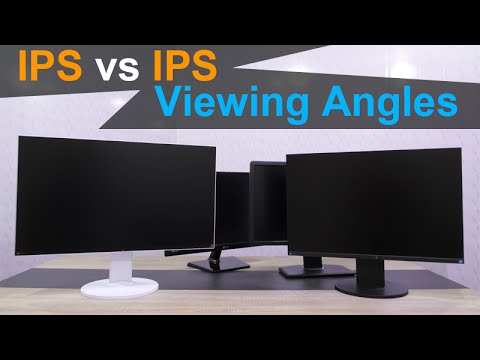
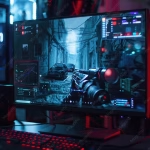
Figuring out how to check if your monitor is an IPS display isn't always as straightforward as you'd hope. Retail packaging rarely spells it out clearly, spec sheets can be vague, and some manufacturers use misleading labels like "IPS-type" on panels that aren't actually IPS at all. IPS (In-Plane Switching) panels are the LCD technology known for wide viewing angles and strong color accuracy, typically rated at 178 degrees horizontal and vertical.
Manufacturer specifications indicate that identifying your panel type reliably comes down to a handful of practical methods: visual testing under the right conditions, looking up the panel's model number, or reading the EDID data your monitor reports to your computer. Let's walk through each one so you can know exactly what you're working with.
Quick Answer
To check if your monitor is IPS, run a viewing angle test by looking at the screen from extreme side angles and below. IPS panels maintain color accuracy and brightness at angles where TN and VA panels show obvious color shift or contrast loss. For certainty, find your monitor's full model number and look up the panel specifications on a database like Panelook or TFTCentral.
Image source: Bing (Web (fair-use with source credit))
Why You Can't Just Read a Spec Sheet and Call It a Day
Here's the frustrating reality: a lot of monitor listings, especially on Amazon and big retail sites, either leave the panel type completely out or use deliberately vague language. You'll see terms like "IPS-level," "wide viewing angle," or "HD IPS" that sound promising but don't guarantee you're getting a true In-Plane Switching panel. Some budget manufacturers slap "IPS" on packaging for panels that are actually VA or TN variants with a wider color filter.
There's another wrinkle. Major brands like Dell, LG, and ASUS sometimes source panels from multiple suppliers for the same monitor model. Your particular unit might have an LG Display IPS panel while someone else's identical model number came with an AUO VA panel.
This is what the monitor community calls "panel lottery." The model number on the box tells you the monitor model, but not necessarily which specific panel ended up inside your unit. That's why hands-on confirmation matters.
The Three Instant Visual Tests Anyone Can Do
You don't need any tools or software to get a strong indication of your panel type. Three quick visual tests will tell you a lot in under five minutes.
The Viewing Angle Tilt Test
This is the single most reliable at-home check. Open a document or any screen with white background and readable text. Sit normally in front of the monitor, then move your head sharply to the left, then the right, then look from below the screen.
Here's what you're watching for:
- IPS: The image stays bright and color-accurate even at extreme off-angles. Text remains readable at 80+ degrees from center.
- TN: Colors invert or shift dramatically at even moderate horizontal angles. Vertical viewing from below washes out heavily.
- VA: Contrast drops noticeably at angles. Colors shift but less severely than TN. Blacks start looking gray when you move off-center.
This behavior is rooted in how each technology aligns liquid crystals. IPS crystals rotate in-plane (parallel to the screen surface), which is why the image holds up at angles. TN crystals twist perpendicularly, which is why the image falls apart the moment you move off-axis.
The IPS Glow Test (Dark Room)
This one is specific to IPS and it's a dead giveaway once you know what to look for. Dim the lights in your room as much as possible. Display a full black image on screen (a solid black PNG or a YouTube video of a black screen works fine).
Look at the corners of the display, especially the bottom corners.
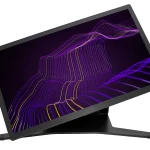
A true IPS panel will show a subtle silvery or white-ish glow in the corners. It looks almost like light is bleeding through from behind the panel in those areas. This is called "IPS glow" and it's a characteristic trade-off of the technology.
It's not a defect. It's inherent to how IPS works.
TN and VA panels don't exhibit this specific corner glow the same way. VA panels may show backlight bleed, but it looks different (more like uneven white patches along edges rather than the concentrated corner shimmer of IPS glow).
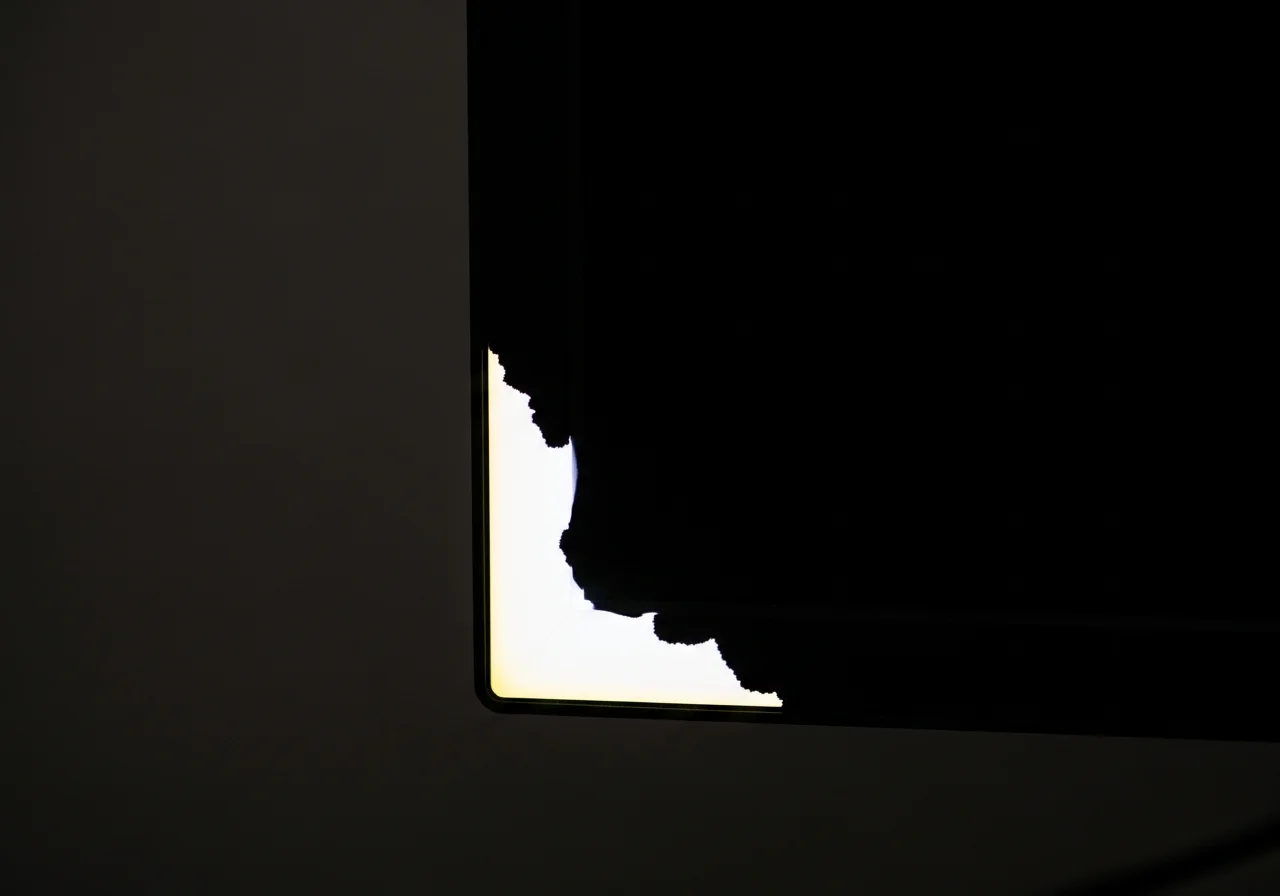
Image source: Bing (Web (fair-use with source credit))
The Contrast Shift Check (Side vs. VA)
Display a photo with rich dark and bright areas. Look at it straight on, then tilt your head about 45 degrees to the side. On an IPS panel, the image will look slightly dimmer but the relationship between darks and lights stays consistent.
The blacks stay looking like blacks. On a VA panel, dark areas will start looking noticeably shallower or more washed out at that angle. This contrast shift is VA's telltale sign and it's distinctly different from the brightness-only reduction you see on IPS.
When Visual Tests Are Enough
If you see wide viewing angles with minimal color shift, plus corner IPS glow in a dark room, you're almost certainly looking at an IPS panel. Those two signs together are very hard to fake with other technologies.
What a Real IPS Display Looks Like From Every Angle
Understanding what to look for helps you interpret the tests above correctly. An IPS panel viewed from center shows consistent brightness and color across the full screen. Move 60 degrees to the left and the image dims maybe 15 to 20 percent but skin tones stay skin tones and blues stay blue.
Move 70 or 80 degrees and the image is noticeably dimmer but still usable, still recognizable, still color-accurate.
From below, IPS panels hold up better than TN but do show some brightness reduction. From above, similar story. This symmetry (similar performance both horizontally and vertically) is a key IPS trait.
Other technologies tend to perform better on one axis than the other.
IPS glow typically appears as a triangular or wedge-shaped silvery patch in one or more corners. It's most visible in dark rooms with dark content. In normal room lighting, you probably won't notice it at all.
A small amount of IPS glow is considered normal and most reviewers flag it as acceptable. Excessive glow would be a quality issue with that specific unit rather than a technology issue.
How IPS Glow Is Different From Backlight Bleed (And Why People Mix Them Up)
People constantly confuse IPS glow with backlight bleed, and honestly, it's easy to see why. Both show up as unwanted light in dark images. But they're distinct phenomena and understanding the difference helps you correctly identify your panel.
| IPS Glow | Backlight Bleed | |
|---|---|---|
| Location | Concentrated at corners, wedge-shaped | Usually along edges, especially bottom |
| Appearance | Silvery, shimmering, almost pearl-like | White or yellowish cloud-like patches |
| Changes with angle | Shifts or changes when you move your head | Stays in same physical location regardless of viewing angle |
| Cause | IPS liquid crystal alignment redirecting backlight unevenly at edges | Backlight LED pressure or frame unevenness |
| Panel type | Specific to IPS (defining characteristic) | Can appear on any LCD type |
| Affects | Acceptable in small amounts, unavoidable to some degree | Always considered a defect or quality issue |
The simplest way to tell them apart: move your head left and right while looking at a black screen in a dark room. IPS glow moves with you. Backlight bleed stays put.
If the bright patch shifts or changes shape as you change your viewing angle, that's IPS glow and it strongly suggests an IPS panel.
When Visual Tests Aren't Enough: Checking the Specs Directly
Sometimes you need certainty, not probability. Maybe you're verifying a used purchase, filing a warranty claim, or just don't trust your own eyes. The definitive route is identifying your actual panel through spec sheets and databases.
Image source: Bing (Web (fair-use with source credit))
Find the Full Model Number
Flip your monitor around and look at the sticker on the back. You need the full model number (something like "LG 27GN950-B" or " Dell U2723QE"), not just the series name. Some monitors also list a "panel code" or "screen model" on this sticker, though that's rare with consumer units.
If you see a short alphanumeric code that looks like a panel designation (like "LM270WQ1" for LG panels), you can look that up directly.
Decode the EDID Data
Your monitor tells your computer exactly what it is through EDID (Extended Display Identification Data). Free tools like HWiNFO or ReadEDID can pull this information. The EDID report includes the manufacturer code, product code, and sometimes the detailed panel identification string.
Cross-reference this data on Panelook.com or TFTCentral's database to find the exact panel model in your display.
Manufacturer OSD Clues
Some monitors display panel information in their on-screen display menu. Check under "System," "Information," or "About" in your monitor's OSD. A few models from BenQ and professional-grade displays from EIZO and NEC show the panel type directly here.
It's not common on consumer monitors, but worth a two-second check.
The Same Model Number Can Have Different Panels — Here's Why
This catches people off guard. You buy the same monitor model as someone else and end up with a completely different panel inside. It happens more often than you'd think.
Monitor manufacturers source panels from multiple suppliers to meet production volumes and negotiate pricing. LG might use an LG Display AH-IPS panel in one production batch and switch to an AUO IPS panel in the next. Both meet the published specs, so the product page doesn't change.
But the actual panel characteristics (response time, coating, glow behavior) can differ between the two.
Higher-end and professional monitors tend to have better panel consistency. A Dell UltraSharp or EIZO ColorEdge is far more likely to use a single panel supplier throughout its production run. Budget and mid-range consumer gaming monitors are where panel lottery is most common.
If you want to verify which specific panel is in your unit, the EDID method above is your best bet. Sites like rtings.com occasionally note in their reviews whether a model uses multiple panel types across units, but this isn't always documented.
IPS vs. TN vs. VA: Quick Visual Reference Guide
Here's a practical side-by-side of the three main LCD panel technologies and what each looks like in the same viewing-angle test.
| Trait | IPS | TN | VA |
|---|---|---|---|
| Viewing angles (side) | Excellent, minimal shift | Poor, color inversion at 30-40 degrees | Good initially, contrast drops past 45 degrees |
| Viewing angles (below) | Good, slight brightness loss | Poor, heavy washout | Moderate, some contrast loss |
| Color accuracy out of box | Typically strong, factory calibrated | Often weak, narrow gamut | Decent, better than TN |
| Contrast ratio (center) | ~1000:1 typical | ~800:1 typical | ~3000:1+ typical |
| Black uniformity | Can show IPS glow in corners | Generally even but washed out | Some clouding in backlight |
| Response time (stock) | 4-5ms GtG typical | 1-2ms GtG typical | 4-8ms GtG typical |
| Dark room corner glow | Yes, IPS glow present | No specific corner glow | Backlight bleed possible along edges |
| Best for | Color work, wide viewing | Competitive esports | Movies, HDR, dark scenes |
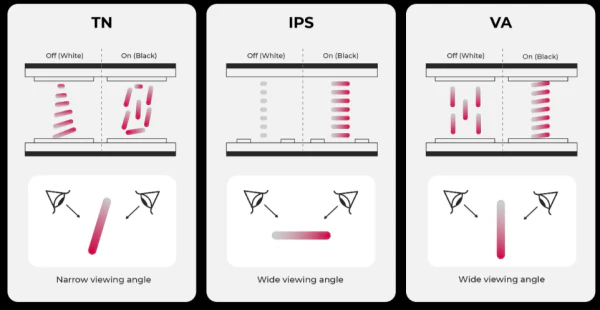
Image source: Bing (Web (fair-use with source credit))
TN Panels: What You'll See
A TN display viewed from center looks fine. The moment you shift even 30 to 40 degrees sideways, colors start inverting. Skin tones go greenish or purplish.
From below, the image washes out almost completely, sometimes appearing as a negative. If you've ever looked at a cheap laptop screen from an angle and seen the image basically disappear, that was TN.
VA Panels: The Tricky Middle Ground
VA panels can be surprisingly hard to distinguish from IPS at a glance. They have decent center contrast (much deeper blacks than IPS at center) and reasonable viewing angles past 30 degrees. The key difference shows up past 45 degrees off-center: VA blacks turn noticeably gray and the whole image loses depth.
An IPS image dims but keeps its punch. A VA image loses its contrast advantage when you move off-axis.
IPS Panels: The Telltale Signs
Wide stable viewing angles plus corner IPS glow in the dark equals IPS. That's the reliable combination. No other panel type checks both boxes.
VA can have wide-ish angles but lacks the IPS glow signature. TN has neither the viewing angles nor the glow. If both signs are present, you're looking at an IPS panel.
When It Actually Matters Which Panel Type You Have
Not everyone needs to care about panel type. But for certain use cases, the difference between IPS, TN, and VA is genuinely significant.
Color-Critical Creative Work
Photographers, graphic designers, and video editors almost always want IPS. The color accuracy, viewing angle stability, and predictable output make it the standard for creative professions. Factory-calibrated IPS panels with wide gamut coverage (98% DCI-P3 or better) are the baseline for serious color work.
Most professional monitors advertised for creative workflows are IPS or IPS Black variants.
Office and Productivity
For spreadsheets, documents, and web browsing, panel type barely matters. An IPS panel is nice if you share your screen with colleagues and they're viewing from different angles. But a decent VA or even a good TN is perfectly fine for solo desk work.
Don't overthink it if productivity is your only concern.
Gaming
Here it depends on what you play and at what level. Competitive esports players chasing the fastest response time still lean toward high-refresh TN panels (some now hit 1ms GtG). But modern Fast IPS panels have largely closed that gap while offering much better image quality.
As of 2026, the majority of gaming monitors sold in the mid-range and above are IPS or Nano IPS variants. For single-player, cinematic gaming, VA's deeper blacks sometimes win fans despite the slower pixel response.
General Use and Casual Viewing
For watching YouTube, browsing, and everyday computer use, any modern panel type is adequate. IPS holds a slight edge for shared viewing because of its wide angles. But you're not going to have a bad experience with a VA or TN for casual use unless the specific unit has quality issues unrelated to its panel type.
The Specs Behind the Visuals: Key Numbers to Know
The visual differences between panel types are rooted in measurable specifications. Here's what the numbers actually mean:
- Viewing angle rating (178°/178°): This is the VESA-standard threshold where contrast ratio drops to 10:1 or less. IPS panels typically hit or exceed this. TN panels often fall well short in practice despite what spec sheets claim.
- Contrast ratio: IPS sits around 1000:1. VA reaches 3000:1 to 5000:1. TN is usually 700:1 to 1000:1. Deeper blacks = higher number.
- Response time (GtG): Gray-to-gray transitions. TN leads at 1ms on paper. Modern IPS panels achieve 1ms with overdrive (Fast IPS), though without overdrive, typical IPS is 4-5ms. VA is generally the slowest at 4-8ms native.
- Color gamut: IPS panels commonly cover 95-100% sRGB with many hitting 95%+ DCI-P3. High-end Nano IPS can cover 98% DCI-P3. TN panels are often limited to 95% sRGB or less on budget units.
- HDR capability: As of 2026, HDR on IPS is generally limited to DisplayHDR 400-600 due to the ~1000:1 contrast limitation. VA panels achieve DisplayHDR 1000 more readily due to their native contrast advantage.
These spec ranges represent typical values across the category. Individual monitors can exceed or fall short depending on the specific panel and manufacturer tuning.
Common Mistakes People Make When Identifying Panel Type
A few errors come up constantly:
Confusing "wide viewing angle" marketing with IPS: Many monitor listings advertise "178° viewing angles" on VA panels. The rated spec doesn't always reflect real-world performance. VA panels can be rated 178°/178° (VESA's low-contrast-threshold definition) but still show visible color and contrast shift at angles where IPS holds steady.
Using a brightly lit room for the glow test: IPS glow is a subtle effect. If your room has ambient light or a window behind you, you won't see it. The test genuinely requires a dark room and a fully black screen to be reliable.
Judging by response time alone: People assume fast response time equals IPS because modern gaming IPS panels advertise 1ms GtG. But TN panels have been at 1ms for years, and some VA panels also advertise 1ms with aggressive overdrive. Response time alone doesn't identify panel type.
Assuming all IPS panels perform the same: Budget IPS panels and premium IPS panels can differ noticeably in glow severity, response time, and color gamut. The technology family (IPS) tells you about viewing angle behavior, but not about overall quality tier.
Opening the monitor to check the panel sticker: This risks voiding your warranty and potentially damaging the unit. Check external labels and software methods first. Only consider opening the chassis if you're comfortable with the risk and the monitor is out of warranty.
Quick Reference Cheat Sheet
Keep this handy for future reference:
| Method | Difficulty | Reliability | Time Needed |
|---|---|---|---|
| Visual viewing angle test | Easy | High (when combined with glow test) | 2 minutes |
| IPS glow test (dark room) | Easy | Very high (definitive for IPS) | 2 minutes |
| Contrast shift test | Easy | Moderate (VA vs. IPS can be close) | 1 minute |
| Model number + panel database lookup | Easy | Very high | 5 minutes |
| EDID data reading with HWiNFO | Moderate | Very high | 10 minutes |
| Manufacturer OSD check | Easy | Low (not always available) | 30 seconds |
Bottom line: The viewing angle test plus the IPS glow test together give you a confident identification most of the time, with zero tools required.
Frequently Asked Questions
Can I check if my monitor is IPS through Windows settings?
Windows doesn't display panel type directly. However, you can read the EDID data using free tools like HWiNFO or MonitorInfoView, which report the monitor's native panel identification. Cross-reference that information on Panelook.com to confirm whether your panel is IPS.
What does IPS glow look like?
IPS glow appears as a silvery or whitish shimmer concentrated in one or more corners of the screen, visible only on a black image in a dark room. It looks different from edge backlight bleed, which appears as cloudy patches along the screen edges. IPS glow shifts with your viewing angle.
Backlight bleed does not.
Are IPS Black panels still IPS?
Yes. IPS Black is LG's improved IPS variant that raises contrast ratio from the typical 1000:1 to around 2000:1. The viewing angle behavior and IPS glow characteristics remain fundamentally the same.
A dark room test on an IPS Black panel will still show corner glow, though it may be less pronounced due to the improved black performance.
Why do some monitors have different panels with the same model number?
Manufacturers sometimes source IPS panels from multiple suppliers (LG Display, AUO, BOE, Innolux) for the same monitor model across different production batches. Both panels meet the published specifications, so the product listing doesn't change. This is known as "panel lottery" and is common in mid-range consumer monitors.
Is IPS glow a defect that I should return my monitor for?
No. IPS glow is an inherent property of the IPS technology and is considered normal behavior. Small amounts of corner glow in a completely dark room are expected on virtually all IPS panels.
It's only a return-worthy issue if the glow is severe enough to distract you during normal use in your typical lighting conditions.
When It Actually Matters Which Panel Type You Have
For casual browsing and office work, any modern panel type serves you fine. But certain workloads make panel type a real, practical difference, not a spec-sheet checkbox.
Photographers, designers, and video editors benefit most from IPS. The color accuracy holds up when you lean in to check details or when a client stands beside you viewing the screen from an angle. An IPS panel with factory calibration and wide gamut coverage (98% DCI-P3 or higher) is essentially mandatory for serious creative output.
Gamers face a genuine choice. Modern Fast IPS panels now hit 1ms GtG with refresh rates up to 360Hz, closing the gap with TN while delivering far better image quality. Aggregate reviews indicate that as of 2026, IPS dominates the mid-range and premium gaming monitor market.
VA panels still appeal to single-player gamers who prioritize deep blacks over pixel speed.
For shared viewing situations, think conference rooms or showing photos to family, IPS wins clearly. The wide, wide angles mean nobody sitting off to the side sees a washed-out or inverted image.
The Specs Behind the Visuals: Key Numbers to Know
Understanding what's happening under the hood helps make sense of the viewing angle and contrast differences you see during visual tests.
Viewing angle ratings (178°/178°) look impressive on spec sheets for all three panel types. Don't take those numbers at face value. The VESA standard defines the viewing angle as the point where contrast ratio drops to 10:1, which is a low bar.
In practice, IPS panels hold color accuracy far better at those angles than VA or TN. The 178° rating tells you when the image technically remains visible, not when it looks good.
Contrast ratio shows the clearest numerical gap between technologies. IPS sits around 1000:1. VA panels reach 3000:1 to 5000:1 naturally.
TN runs around 800:1 to 1000:1. This is why VA blacks look meaningfully deeper at center screen and why IPS panels can't match VA in dark room HDR performance without local dimming.
Response time has improved dramatically for IPS. Early IPS monitors clocked 12 to 16ms GtG, using IPS as a dirty word among gamers. Today's Fast IPS and Nano IPS panels reliably hit 1ms GtG with overdrive enabled.
Without overdrive, expect 4 to 5ms GtG on a typical 2025/2026 IPS gaming panel. TN still leads the raw speed race, but the practical gap has narrowed enough that IPS is the safer all-round choice for most people.
Color gamut is where IPS consistently earns its premium. Most IPS panels ship with 95% to 100% sRGB as standard. Many mid-range and premium units cover 95% to 98% DCI-P3.
Budget TN panels often cap out at 95% sRGB or lower. If you needWide-gamut color work, IPS is almost always the only LCD technology that delivers it consistently.
Common Mistakes People Make When Identifying Panel Type
Even after reading a guide like this, people keep falling into the same traps. The most common one is relying on the product listing alone. If the box or product page doesn't explicitly say "IPS," do not assume anything.
Marketing language like "wide viewing angle," "IPS-level," or "178-degree visibility" does not confirm an IPS panel. VA manufacturers use the exact same phrasing.
Another mistake is running the glow test in a lit room. IPS glow is subtle. Even moderate ambient light drowns it out completely and leaves you staring at a dark screen seeing nothing useful.
Find the darkest room you can, give your eyes a minute to adjust, and use a pure black image filling the entire screen.
People also confuse response time specs with panel type. A monitor advertising 1ms response time could be TN, could be Fast IPS, could be a VA panel with aggressive overdrive. Response time tells you about pixel speed, not about the underlying LCD technology.
Finally, don't assume your specific unit matches the panel type in a review you watched or read online. Remember panel lottery. If a reviewer's unit has an IPS panel, that's encouraging but not a guarantee yours will match.
The only ways to know for certain are your own visual tests on your own unit or the EDID/panel database lookup for your specific serial batch.
Quick Reference Cheat Sheet
Here's everything from this guide compressed into a scannable format you can come back to.
Fastest free checks (no tools needed)
- Sit in front of your monitor. Tilt your head sharply left, right, and look from below. IPS colors stay accurate. TN colors invert. VA contrast drops.
- Kill the lights. Display full black. Check corners for silvery glow. That glow means IPS.
Definitive identification (takes five minutes)
- Find the model number sticker on the back of your monitor.
- Search the model on Panelook.com or TFTCentral.
- Or run HWiNFO and cross-reference the EDID panel ID.
What separates IPS from the alternatives
- IPS has the widest, most consistent viewing angles with minimal color shift.
- IPS has corner glow in dark rooms (TN does not, VA has edge bleed instead).
- IPS holds its contrast ratio better at off-angles than VA.
- IPS offers wider color gamut coverage than TN at every price tier.
Frequently Asked Questions
Do IPS monitors have worse HDR than VA monitors?
Generally, yes. Most IPS panels around 1000:1 contrast ratio can't deliver the deep blacks that VA panels achieve at 3000:1 to 5000:1. HDR content relies heavily on contrast between bright highlights and dark shadows, giving VA a native advantage.
IPS Black improves this gap with contrast around 2000:1, but it still doesn't match VA for HDR impact without local dimming.
Can a VA panel ever look like IPS from straight on?
Absolutely. Viewed dead-center, a good VA panel with wide color gamut looks excellent and can easily be mistaken for IPS. The difference only becomes obvious when you move off-center and VA's contrast advantage evaporates while IPS holds steady.
That's exactly why the viewing angle test matters so much for identification.
Is the IPS glow visible during normal use?
Almost never. IPS glow shows up primarily in dark rooms with dark content. In a normally lit room watching normal content, you likely won't notice it at all.
People who game or watch movies in a pitch-black room notice it more, but even then, mild glow is considered normal and not a defect worth returning over.
How reliable are panel identification sites like Panelook?
Panelook and TFTCentral maintain extensive databases of panel specifications and are considered the most reliable public sources for this information. Panel manufacturer specifications confirm that panel codes included in these databases are sourced from official datasheets. The main limitation is that they may not have information on the very newest or most obscure panel models.
Do professional monitors like Dell UltraSharp always use IPS?
Nearly all Dell UltraSharp and professional creative monitors use IPS technology. Most use IPS or updated IPS Black variants. Some professional displays from EIZO and NEC use IPS as well.
The consistent viewing angles and color accuracy of IPS make it the default technology for workstations where color fidelity matters.
Final Word
Check your viewing angles, look for that telltale corner glow in a dark room, and run your model number through a panel database if needed. You'll know what panel you have.
Quick recap of the most reliable methods:
- Viewing angle test from the sides (IPS holds color, TN inverts, VA loses contrast)
- Dark room black screen check (silvery corner glow signals IPS)
- Model number lookup on Panelook or TFTCentral (definitive confirmation)
- EDID data via HWiNFO (direct panel identification)
Combine two or three of these and you'll never wonder about your panel type again.
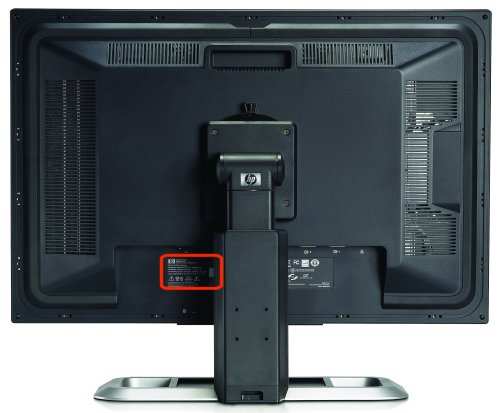
Image source: Bing (Web (fair-use with source credit))

Similar Posts