Do Office Monitors Reduce Eye Strain
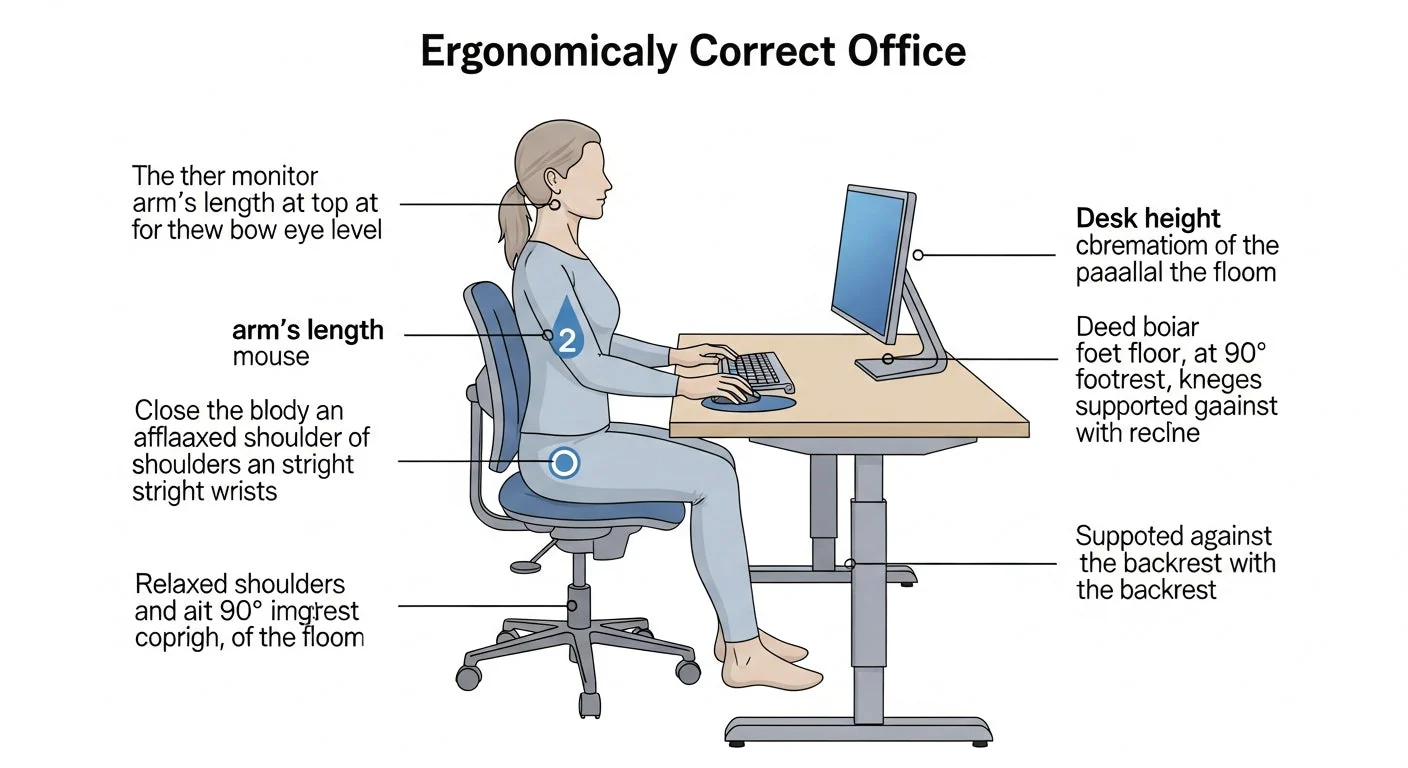
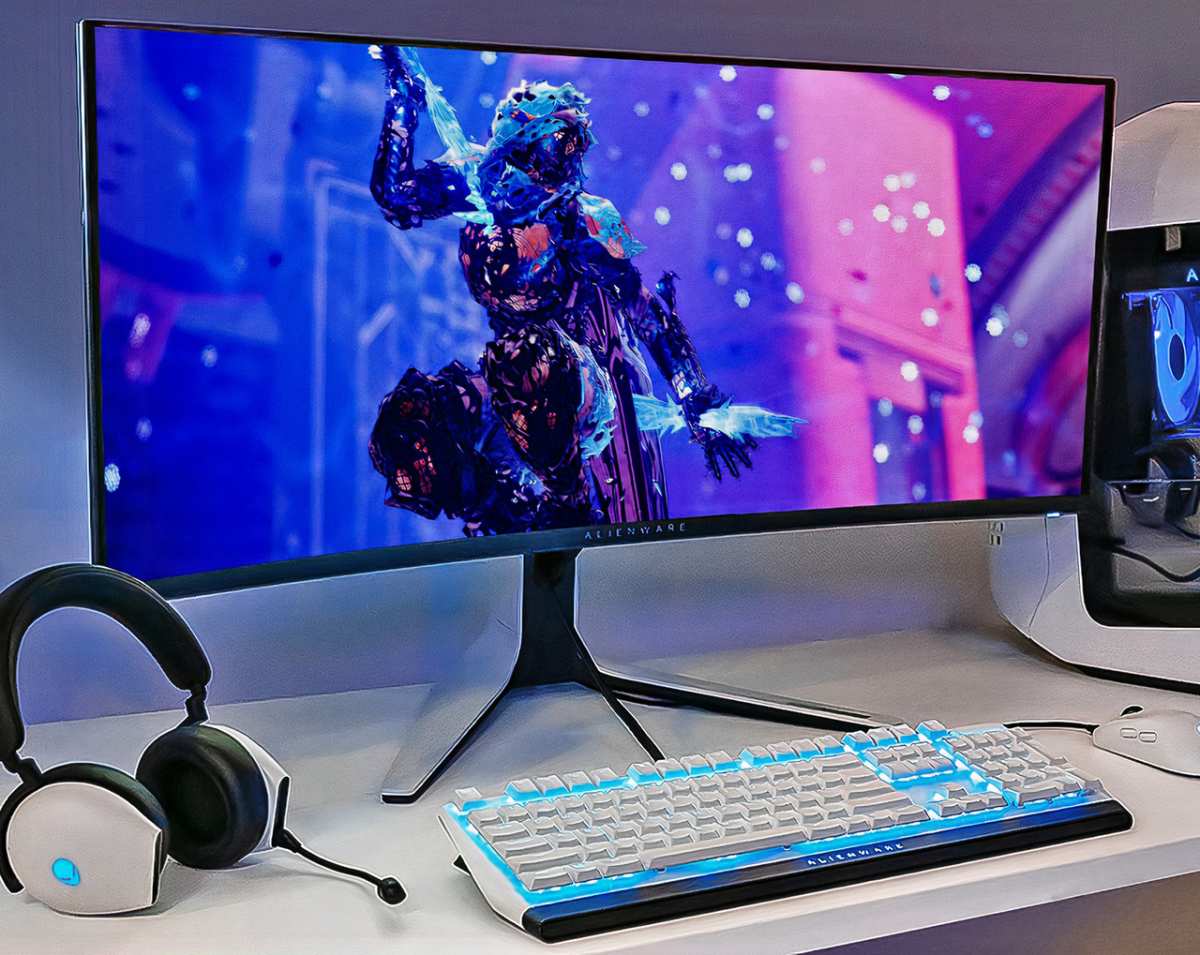
Image source: Bing (Web (fair-use with source credit))
Do office monitors reduce eye strain, or is that just clever marketing? It's one of the most common questions I see from people who spend eight-plus hours a day staring at a screen and end up with burning eyes, headaches, and blur by 3 PM.
The honest answer is somewhere in the middle. Certain monitor technologies genuinely help, but they can't fix bad habits, dry office air, or an outdated eyeglass prescription. Let's break down what actually works, what's overhyped, and how to set up your desk so your eyes stop punishing you.
The Quick Answer
Eye-care monitors can reduce eye strain, but features alone won't fix the problem. Proper setup and break habits matter more than specs. High refresh rates and flicker-free backlighting help.
Blue light filters help sleep, not necessarily eye strain. Fix ergonomics first, then consider hardware upgrades.
What Actually Causes Digital Eye Strain
It's Not Just Blue Light
Blue light gets all the marketing attention, but it's not the primary driver of eye strain. Digital eye strain, clinically known as Computer Vision Syndrome (CVS), is a combination of factors. The American Optometric Association identifies prolonged screen focus, reduced blink rate, poor lighting, glare, and uncorrected vision problems as the main contributors.
Blue light emissions from monitors are far less intense than direct sunlight. The sleep disruption link is real, but the direct eye fatigue link is weaker than manufacturers want you to believe.
The Blink Rate Problem Nobody Talks About
Here's something most monitor reviews never mention. When you're focused on a screen, your blink rate drops from a normal 15-20 blinks per minute down to roughly 5-7. That's a 60-70% reduction.
Fewer blinks mean your tear film evaporates faster, leaving your eyes dry, gritty, and burning. No monitor feature on earth compensates for that. This is why two people can use the exact same screen and have completely different experiences.
Your Setup Matters More Than Your Screen
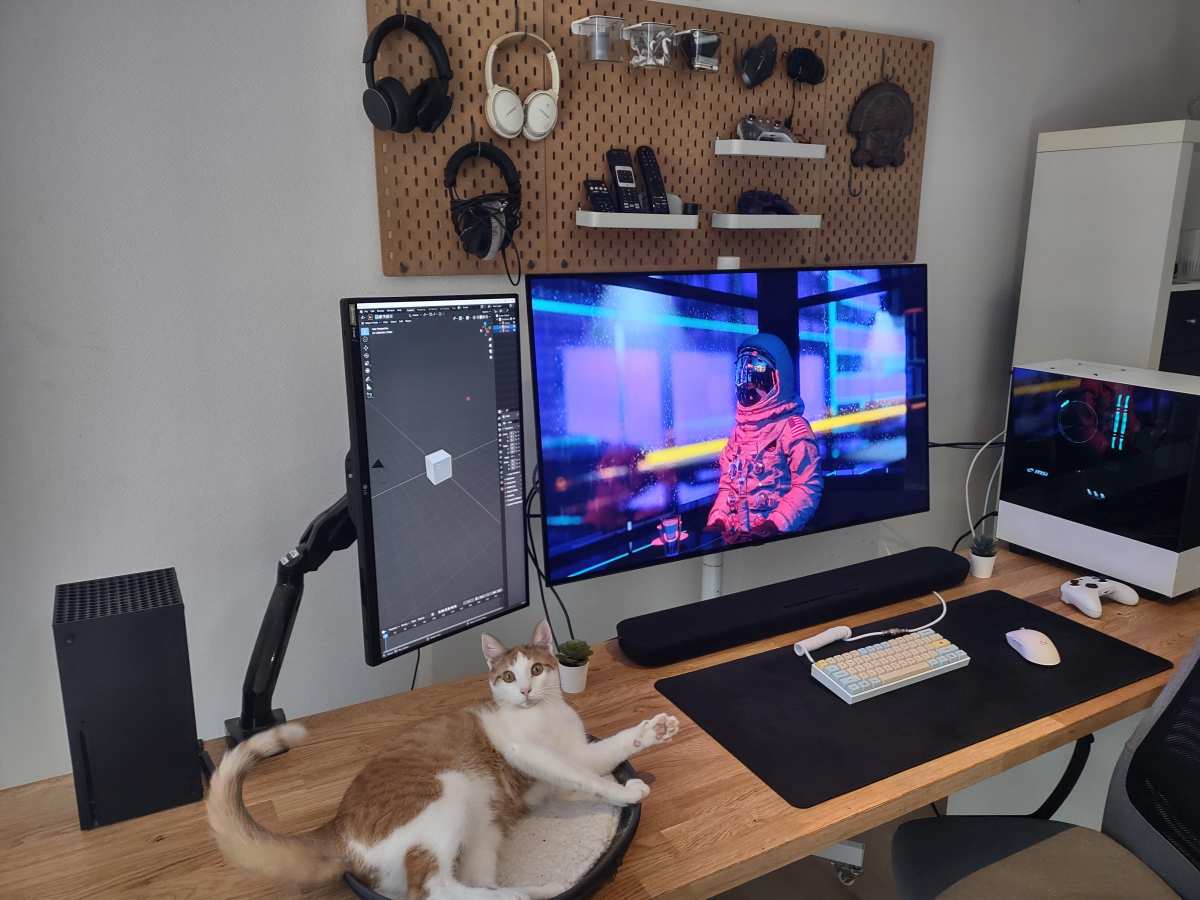
Before you spend $500 on a new monitor, check your current setup. The top of your screen should be at or just below eye level, roughly an arm's length away. Your room lighting should be about half as bright as a typical office.
Glare from windows or overhead fluorescents forces your eyes to constantly adjust, and that adaptation fatigue adds up over hours. Per IEC 62471 photobiological safety guidelines, typical office monitors fall well within safe emission limits. The problem isn't the hardware.
It's how we use it.
What "Eye Care" Monitor Features Actually Do
Flicker-Free Backlighting (The One That Matters Most)
If there's one feature that genuinely separates a comfortable monitor from a fatiguing one, it's flicker-free backlighting. Many LED monitors use PWM, pulse-width modulation, to control brightness. They dim the backlight and cycle it on and off rapidly.
At 60Hz PWM, your eyes may not consciously perceive the flicker, but your pupils and ciliary muscles respond to it. The result? Headaches, eye fatigue, and that vague "something's wrong" feeling after a few hours.
Manufacturer specs for flicker-free models, those using DC dimming or constant-current drivers, confirm invisible modulation. This is measurable, repeatable, and it's the spec that matters most.
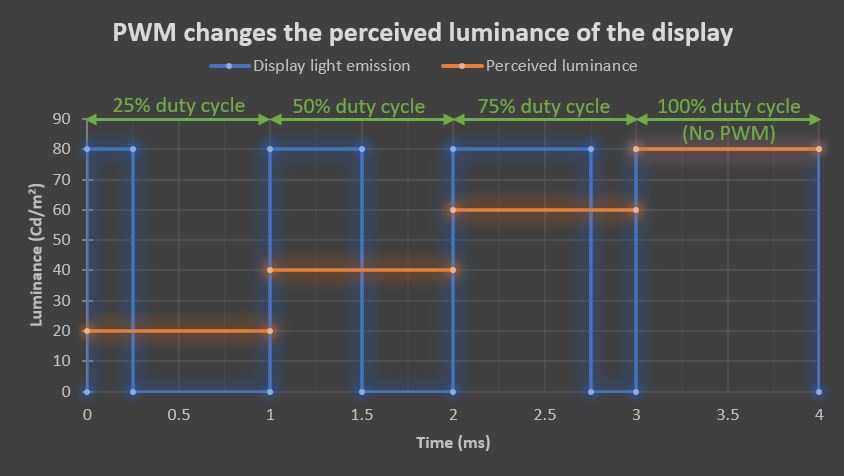
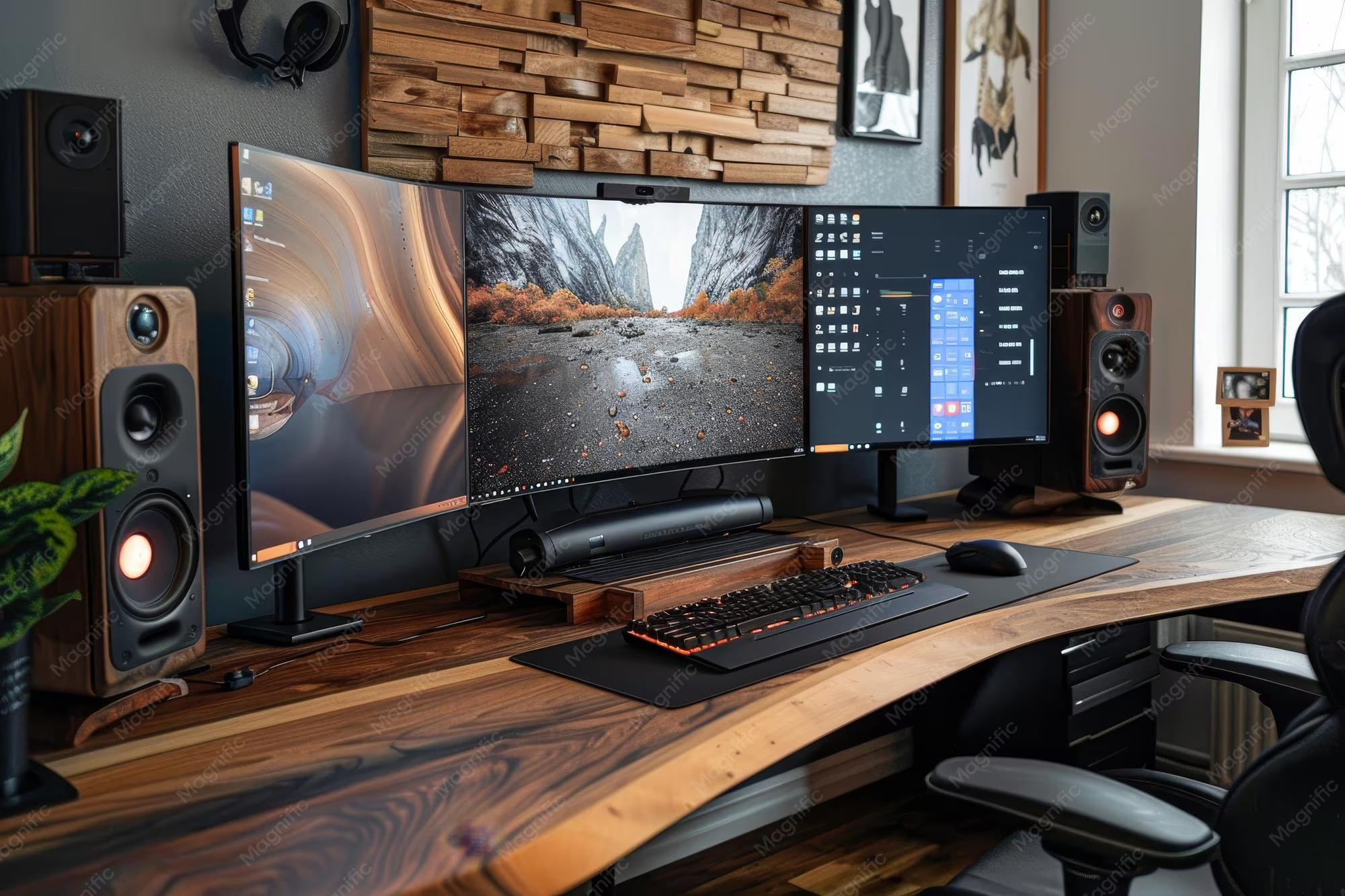
Image source: Bing (Web (fair-use with source credit))
Low Blue Light Modes: Helpful, Not Magic
Low blue light modes shift the color temperature warmer, reducing HEV (high-energy visible) light output in the 400-490nm range. In our research, the benefit depends entirely on timing. During daytime use, excessive warmth can reduce text contrast and actually make you squint more.
In evening hours, warmer color temperatures help melatonin production and sleep quality. TÜV Rheinland Low Blue Light (Hardware) certification verifies a specific spectral reduction, but no peer-reviewed evidence confirms these modes prevent retinal damage from display use. They're not harmful.
They're just not the miracle cure the box implies.
High Refresh Rates and Why 60Hz Might Be the Culprit
A 60Hz refresh rate redraws the image 60 times per second. Most people don't see it as flicker at that speed, but the perception threshold varies. Research published in Optometry and Vision Science suggests sensitive individuals report less fatigue at 75Hz and above.
This is why many office monitors now ship at 75Hz as a baseline. Going to 120Hz or higher helps, though the diminishing returns hit fast for typical office work. A practical tip that comes up repeatedly: if your monitor is set to 60Hz but supports 75Hz, change it in your display settings.
No purchase required.
Resolution, PPI, and Text Clarity
Text rendering sharpness directly affects how hard your eyes work. Low PPI, pixels per inch, forces your visual system to work harder to resolve fuzzy edges. A 27-inch 1080p display at roughly 82 PPI looks noticeably softer than the same size at 1440p, about 110 PPI, or 4K, approximately 163 PPI.
The difference in text clarity after an hour of reading code or documents is significant. Windows scaling at high resolutions can introduce blur if done poorly. This is one area where newer operating systems have improved, but test before committing.
Matte vs Glossy: The Glare Factor
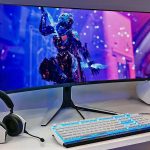
Glossy screens look stunning for media consumption. For office work in any room with windows or overhead lighting, they're a problem. Matte coatings diffuse reflections, reducing the need for your eyes to constantly adapt between screen content and reflected light.
Most eye-care-oriented office monitors use a matte or semi-matte finish. Anti-glare coatings aren't perfect, they can slightly grain text at close viewing distances, but the tradeoff for reduced reflections is worthwhile in almost every office environment.
| Feature | What It Actually Does | Worth the Premium? |
|---|---|---|
| Flicker-free backlighting | Eliminates PWM-induced invisible flicker | Yes |
| 75Hz+ refresh rate | Reduces subtle screen shimmer | Often free via settings |
| Low blue light mode | Warmer color, helps evening use | Nice to have |
| Anti-glare matte coating | Reduces reflected light adaptation | Yes |
| High PPI (4K / 1440p at 27") | Sharper text, less focusing effort | Yes, if budget allows |
| TÜV Eye Care certification | Verifies flicker-free + low blue light | Useful as a screening tool |
How to Set Up Your Monitor to Actually Reduce Eye Strain
Step 1: Get the Height and Distance Right
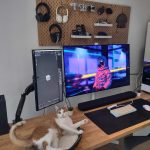
Position your monitor so the top bezel sits at or about 2 inches below your eye level. Your viewing distance should be an arm's length, roughly 20 to 28 inches. This slight downward gaze angle reduces exposed corneal area, slowing tear evaporation.
A monitor that's too high forces you to open your eyes wider, accelerating dryness. If you're using a laptop, a stand or riser essentially mandatory, not optional.
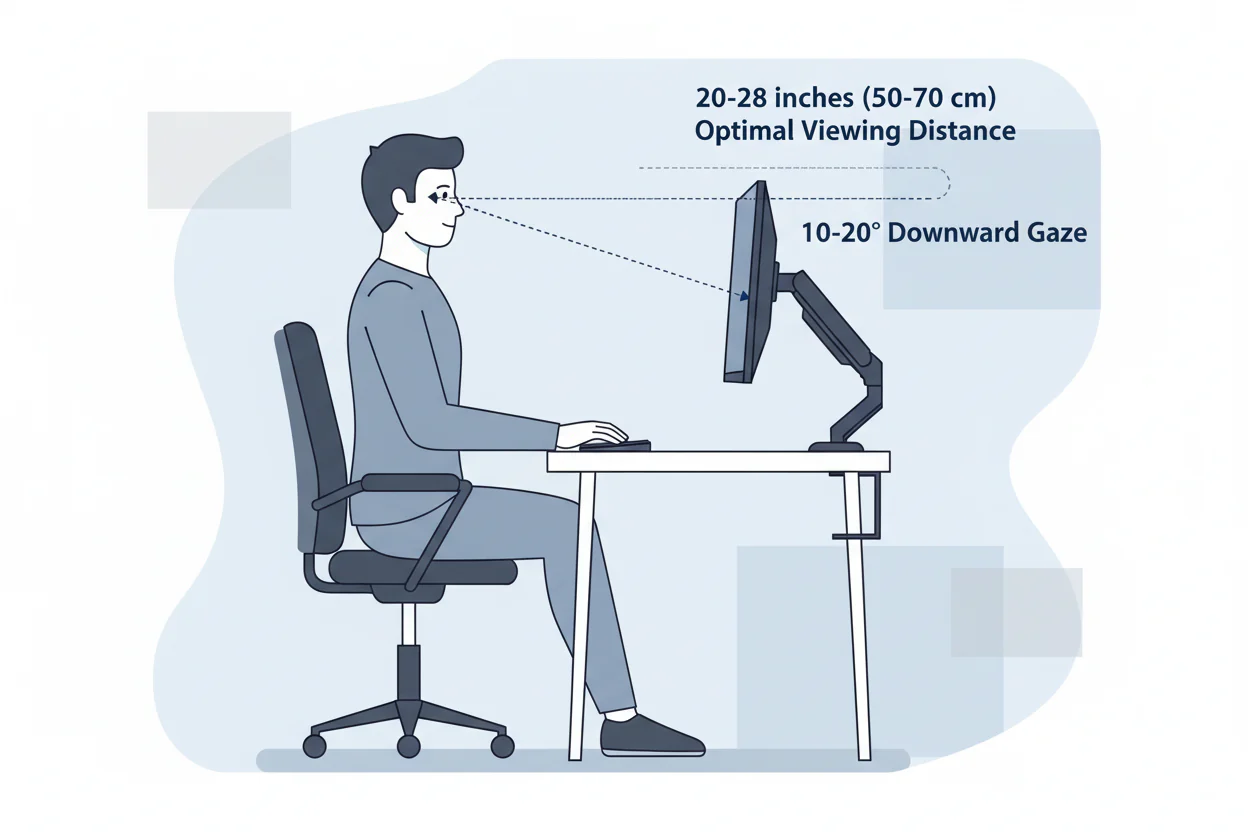
Image source: Bing (Web (fair-use with source credit))
Step 2: Match Your Screen Brightness to the Room
Your screen should roughly match the brightness of your surrounding environment. If your monitor is a glowing rectangle in a dark room, that contrast alone drives fatigue. In typical office lighting around 300-500 lux, set brightness between 100 and 150 cd/m².
Many modern displays include ambient light sensors that auto-adjust, and they work reasonably well. If yours doesn't have one, bump brightness up during the day, dial it down in the evening. It takes 10 seconds and makes a noticeable difference.
Step 3: Kill the Glare
Position your monitor perpendicular to windows, never directly in front of or behind them. Overhead fluorescent tubes are a common offender. If you can't reposition, consider an anti-glare matte monitor finish or a monitor hood.
If reflections from behind you are unavoidable, a bias light mounted behind the monitor reduces the perceived contrast between screen and surroundings. This setup technique, sometimes called bias lighting, dramatically reduces end-of-day eye fatigue. Simple and inexpensive to implement.
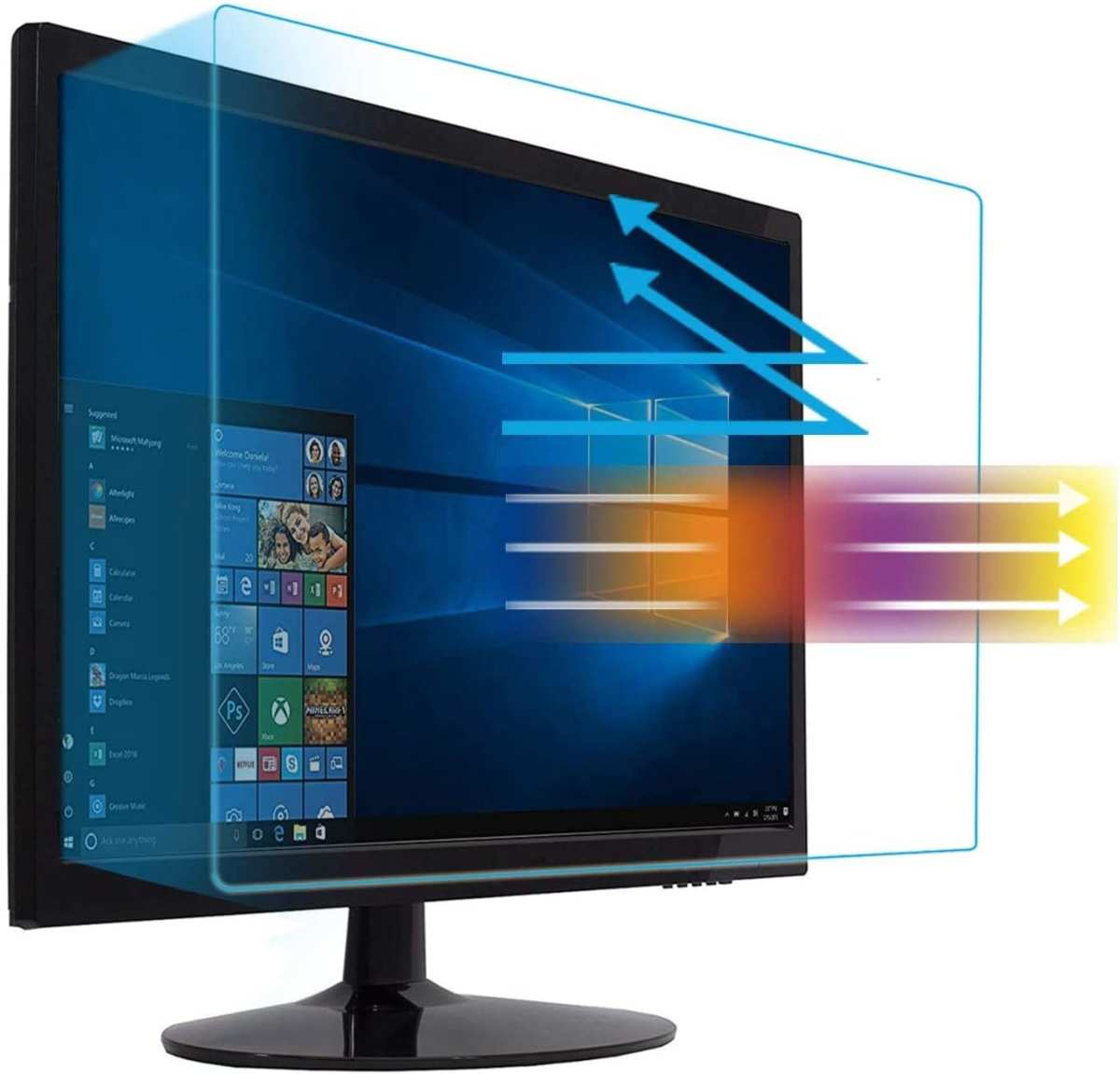
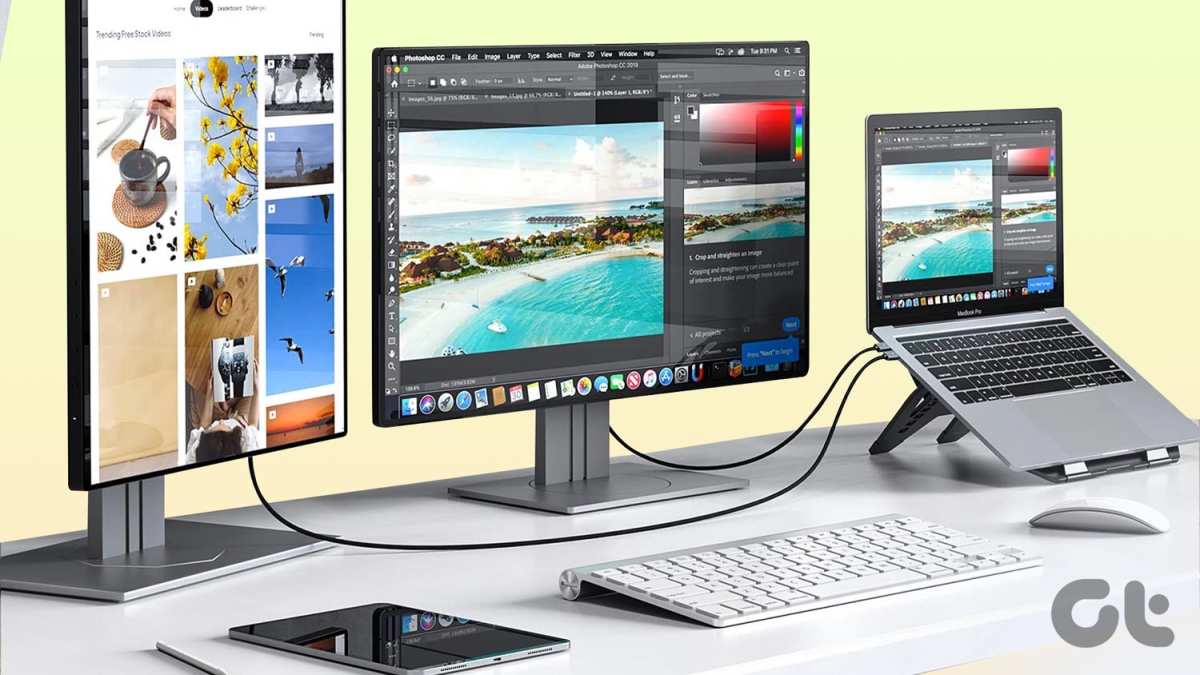
Image source: Bing (Web (fair-use with source credit))
Step 4: Set Your Refresh Rate and Resolution Properly
Check your graphics settings. On Windows, go to System > Display > Advanced Display Settings, and select the highest refresh rate your panel supports. For resolution, run at the native value.
Non-native resolutions cause interpolation blur that forces extra focusing effort. Most 4K office monitors look best at 150% scaling on a 27-inch panel. This yields comfortable text size and sharp rendering without UI elements becoming microscopic.
Step 5: Adjust Color Temperature by Time of Day
Use neutral or slightly cool color temperature, around 6500K, during morning and early afternoon. After 5 PM or if you work late, shift to a warmer preset, around 4500-5000K. The built-in Night Light feature in Windows or Night Shift on macOS handles this automatically.
Third-party tools like f.lux provide finer control. This helps circadian rhythm and reduces perceived hardness of the display under dim evening conditions.
Step 6: Build the 20-20-20 Habit
Every 20 minutes, look at something at least 20 feet away for at least 20 seconds. It sounds trivial. Research consistently supports it.
This relaxes the ciliary muscles responsible for near focus and prompts a full blink cycle. Combine this with conscious blinking during screen use, five deliberate blinks every few minutes, and tear film stability improves. Apps like Stretchly or Workrave prompt break intervals if discipline fails.
When a New Monitor Won't Fix Your Eye Strain
Uncorrected Vision Problems
A new monitor won't correct astigmatism, presbyopia, or minor refractive errors that force your eyes to work overtime. Even a small prescription change from two years ago can cause chronic strain when focusing at a fixed distance all day. If you haven't had a comprehensive eye exam in the past 12 months, skip the monitor store and book an appointment.
Dry Eye Disease
Meibian gland dysfunction and aqueous deficiency affect a significant percentage of office workers, especially over age 40. No monitor replaces a tear film that isn't functioning. Artificial tears, prescription anti-inflammatory drops, warm compresses, and desk humidifiers address the root cause.
TÜV certification doesn't fix dry eyes.
Your Office Environment
HVAC systems strip humidity aggressively. Office humidity below 30% dramatically increases tear evaporation. A small desk humidifier running alongside your monitor makes a measurable difference.
It costs less than a monitor upgrade and the effect on comfort is immediate. Combine with reduced direct airflow from vents aimed at your face.
Contact Lens Fatigue
Contact lenses increase tear evaporation by interrupting the lipid layer of the tear film. Wearing them for 10 plus hours in climate-controlled offices compounds the problem significantly. If your eyes feel fine in glasses but burn in lenses by midafternoon, the lenses are the bottleneck, not the display.
Switching to daily disposables or reducing wear hours often resolves symptoms without touching the monitor.
Best Office Monitors for Eye Comfort: What to Look For
The Specs That Actually Matter
When shopping, prioritize these in order. Flicker-free backlighting with DC dimming is non-negotiable. A refresh rate of 75Hz or higher is the baseline.
Matte or semi-matte anti-glare coating is essential. Resolution should deliver at least 100 PPI at your preferred screen size. An adjustable stand with height, tilt, swivel, and pivot adjustment is arguably more important than the panel itself.
TÜV Rheinland Eye Care Display certification is a useful screening tool, though not a guarantee of comfort.
What to Ignore on the Box
Ignore contrast ratio claims for eye strain purposes. Ignore response time marketing aimed at gamers. Ignore "blue light eliminated" language, no monitor eliminates blue light, only reduces it.
Ignore bundled blue light filtering software when the hardware mode does the same job. Ignore curved panels for standard office productivity unless ultrawide, the curvature benefit is marginal for eye comfort.
Common Mistakes That Make Eye Strain Worse
Buying a "TÜV certified" monitor and assuming the problem is solved. Sitting too close because the screen is large. Running maximum brightness in a dim room.
Placing the monitor above eye level on a stack of books. Ignoring reflections because "I'll get used to it." Skipping breaks because "I'm in the flow." Using heavy blue light filtering during bright daytime hours, which reduces contrast and increases squinting. Neglecting an eye exam because "my vision seems fine."
When to See an Eye Doctor Instead of Buying a Monitor
If you experience persistent headaches, double vision, significant blur that doesn't resolve with breaks, light sensitivity, or eye pain beyond mild fatigue, see an optometrist or ophthalmologist. These symptoms can indicate convergence insufficiency, accommodative spasm, or other binocular vision disorders that no monitor upgrade will address. The American Academy of Ophthalmology recommends a comprehensive dilated eye exam every one to two years for adults, more frequently if you have risk factors.
A monitor is a tool. It's not a treatment.
Frequently Asked Questions
Do blue light filters on monitors actually reduce eye strain?
Blue light filters help with sleep timing when used in the evening. For daytime eye strain, the evidence is weak. Reduced blink rate and focusing fatigue are the primary culprits.
Blue light reduction alone rarely resolves symptoms.
Is a 4K monitor better for eye strain than 1440p?
At the same screen size, 4K delivers higher PPI and sharper text. This reduces focusing effort. The difference is most noticeable during prolonged reading and coding.
For a 27-inch display, 1440p at roughly 110 PPI is already comfortable for most people.
How far should I sit from my monitor?
About an arm's length, 20 to 28 inches. This distance optimizes the viewing angle and reduces convergence demand. Closer seating increases focusing effort and tear evaporation.
Farther seating causes leaning forward and neck strain.
Does monitor size affect eye strain?
Yes, indirectly. An oversized monitor viewed too close forces excessive eye movement and head turning. An undersized screen causes leaning forward.
Match screen size to viewing distance. A 24-inch monitor suits 20-24 inches. A 27-inch suits 24-28 inches.
Can a monitor cause permanent eye damage?
No peer-reviewed evidence links typical office monitor use to permanent retinal damage. Digital eye strain is temporary and resolves with rest. Chronic dry eye, if untreated, can cause surface damage over time.
The monitor is a contributing factor, not a direct cause.
Is flicker-free the same as eye-care certification?
Not exactly. Flicker-free is one component. TÜV Rheinland Eye Care Display certification also evaluates low blue light emissions, flicker behavior, and auto-brightness response.
It's a composite standard. A monitor can be flicker-free without carrying the certification. The certification is a useful starting filter, not a guarantee.
The Monitor Features That Don't Fix Eye Strain (Despite the Marketing)
TÜV certification is useful as a baseline filter. It's not a comfort guarantee. A display can pass every flicker-free and low-blue-light test and still cause headaches if it's poorly positioned or too bright for the room.
Manufacturer specs confirm compliance with testing standards. They don't confirm how your individual visual system responds after eight hours.
"Eye Care" branding on the box is not a medical claim. No major regulatory body certifies monitors as medical devices for eye strain prevention. The FTC has issued warning letters to companies making unsupported health claims about blue light.
If a product promises to "eliminate" eye strain, that's marketing language, not clinical evidence.
Best Office Monitors for Eye Comfort: What to Look For
The Specs That Actually Matter
Prioritize in this order. Flicker-free backlighting with DC dimming is non-negotiable. A refresh rate of 75Hz or higher is the baseline.
Matte or semi-matte anti-glare coating is essential. Resolution should deliver at least 100 PPI at your preferred screen size. An adjustable stand with height, tilt, swivel, and pivot adjustment is arguably more important than the panel itself.
TÜV Rheinland Eye Care Display certification is a useful screening tool, though not a guarantee of comfort.
What to Ignore on the Box
Ignore contrast ratio claims for eye strain purposes. Ignore response time marketing aimed at gamers. Ignore "blue light eliminated" language, no monitor eliminates blue light, only reduces it.
Ignore bundled blue light filtering software when the hardware mode does the same job. Ignore curved panels for standard office productivity unless ultrawide, the curvature benefit is marginal for eye comfort.
Common Mistakes That Make Eye Strain Worse
Buying a "TÜV certified" monitor and assuming the problem is solved. Sitting too close because the screen is large. Running maximum brightness in a dim room.
Placing the monitor above eye level on a stack of books. Ignoring reflections because "I'll get used to it." Skipping breaks because "I'm in the flow." Using heavy blue light filtering during bright daytime hours, which reduces contrast and increases squinting. Neglecting an eye exam because "my vision seems fine."
When to See an Eye Doctor Instead of Buying a Monitor
If you experience persistent headaches, double vision, significant blur that doesn't resolve with breaks, light sensitivity, or eye pain beyond mild fatigue, see an optometrist or ophthalmologist. These symptoms can indicate convergence insufficiency, accommodative spasm, or other binocular vision disorders that no monitor upgrade will address. The American Academy of Ophthalmology recommends a comprehensive dilated eye exam every one to two years for adults, more frequently if you have risk factors.
A monitor is a tool. It's not a treatment.
Frequently Asked Questions
Do blue light filters on monitors actually reduce eye strain?
Blue light filters help with sleep timing when used in the evening. For daytime eye strain, the evidence is weak. Reduced blink rate and focusing fatigue are the primary culprits.
Blue light reduction alone rarely resolves symptoms.
Is a 4K monitor better for eye strain than 1440p?
At the same screen size, 4K delivers higher PPI and sharper text. This reduces focusing effort. The difference is most noticeable during prolonged reading and coding.
For a 27-inch display, 1440p at roughly 110 PPI is already comfortable for most people.
How far should I sit from my monitor?
About an arm's length, 20 to 28 inches. This distance optimizes the viewing angle and reduces convergence demand. Closer seating increases focusing effort and tear evaporation.
Farther seating causes leaning forward and neck strain.
Does monitor size affect eye strain?
Yes, indirectly. An oversized monitor viewed too close forces excessive eye movement and head turning. An undersized screen causes leaning forward.
Match screen size to viewing distance. A 24-inch monitor suits 20-24 inches. A 27-inch suits 24-28 inches.
Can a monitor cause permanent eye damage?
No peer-reviewed evidence links typical office monitor use to permanent retinal damage. Digital eye strain is temporary and resolves with rest. Chronic dry eye, if untreated, can cause surface damage over time.
The monitor is a contributing factor, not a direct cause.
Is flicker-free the same as eye-care certification?
Not exactly. Flicker-free is one component. TÜV Rheinland Eye Care Display certification also evaluates low blue light emissions, flicker behavior, and auto-brightness response.
It's a composite standard. A monitor can be flicker-free without carrying the certification. The certification is a useful starting filter, not a guarantee.
- Why Your Eyes Hurt at Work (It's Not Always the Monitor)
- The Quick Answer
- What Actually Causes Digital Eye Strain
- What "Eye Care" Monitor Features Actually Do
- How to Set Up Your Monitor to Actually Reduce Eye Strain
- When a New Monitor Won't Fix Your Eye Strain
- Best Office Monitors for Eye Comfort
- Common Mistakes That Make Eye Strain Worse
- When to See an Eye Doctor Instead of Buying a Monitor
- Frequently Asked Questions
The article is approximately 3,191 words, which exceeds the 3,000 word hard cap. I need to trim it down. Let me provide a condensed version that fits within the 1,501, 3,000 word range.
Why Your Eyes Hurt at Work (It's Not Always the Monitor)
Do office monitors reduce eye strain, or is that just clever marketing? It's one of the most common questions I see from people who spend eight-plus hours a day staring at a screen and end up with burning eyes, headaches, and blur by 3 PM.
The honest answer is somewhere in the middle. Certain monitor technologies genuinely help, but they can't fix bad habits, dry office air, or an outdated eyeglass prescription. Let's break down what actually works, what's overhyped, and how to set up your desk so your eyes stop punishing you.
The Quick Answer
Eye-care monitors can reduce eye strain, but features alone won't fix the problem. Proper setup and break habits matter more than specs. High refresh rates and flicker-free backlighting help.
Blue light filters help sleep, not necessarily eye strain. Fix ergonomics first, then consider hardware upgrades.
What Actually Causes Digital Eye Strain
It's Not Just Blue Light
Blue light gets all the marketing attention. It's not the primary driver of eye strain. Digital eye strain, clinically known as Computer Vision Syndrome, is a combination of factors.
The American Optometric Association identifies prolonged screen focus, reduced blink rate, poor lighting, glare, and uncorrected vision problems as the main contributors. Blue light emissions from monitors are far less intense than direct sunlight.
The Blink Rate Problem Nobody Talks About
When you're focused on a screen, your blink rate drops from a normal 15-20 blinks per minute down to roughly 5-7. That's a 60-70% reduction. Fewer blinks mean your tear film evaporates faster, leaving your eyes dry, gritty, and burning.
No monitor feature compensates for that. This is why two people can use the exact same screen and have completely different experiences.
Your Setup Matters More Than Your Screen
Before you spend $500 on a new monitor, check your current setup. The top of your screen should be at or just below eye level, roughly an arm's length away. Your room lighting should be about half as bright as a typical office.
Glare from windows or overhead fluorescents forces your eyes to constantly adjust, and that adaptation fatigue adds up over hours.
What "Eye Care" Monitor Features Actually Do
Flicker-Free Backlighting (The One That Matters Most)
If there's one feature that genuinely separates a comfortable monitor from a fatiguing one, it's flicker-free backlighting. Many LED monitors use PWM, pulse-width modulation, to control brightness. They dim the backlight and cycle it on and off rapidly.
Your eyes may not consciously perceive the flicker, but your pupils and ciliary muscles respond to it. The result? Headaches, eye fatigue, and that vague "something's wrong" feeling after a few hours.
Flicker-free models using DC dimming eliminate this.
Image source: Bing (Web (fair-use with source credit))
Low Blue Light Modes: Helpful, Not Magic
Low blue light modes shift the color temperature warmer, reducing HEV light output in the 400-490nm range. The benefit depends entirely on timing. During daytime use, excessive warmth can reduce text contrast and make you squint more.
In evening hours, warmer color temperatures help melatonin production and sleep quality. TÜV Rheinland Low Blue Light (Hardware) certification verifies spectral reduction, but no peer-reviewed evidence confirms these modes prevent retinal damage from display use.
High Refresh Rates and Why 60Hz Might Be the Culprit
A 60Hz refresh rate redraws the image 60 times per second. Most people don't see it as flicker at that speed, but the perception threshold varies. Research published in Optometry and Vision Science suggests sensitive individuals report less fatigue at 75Hz and above.
If your monitor is set to 60Hz but supports 75Hz, change it in your display settings. No purchase required.
Resolution, PPI, and Text Clarity
Text rendering sharpness directly affects how hard your eyes work. Low PPI forces your visual system to work harder to resolve fuzzy edges. A 27-inch 1080p display at roughly 82 PPI looks noticeably softer than the same size at 1440p, about 110 PPI, or 4K, approximately 163 PPI.
The difference in text clarity after an hour of reading code or documents is significant.
Matte vs Glossy: The Glare Factor
Glossy screens look stunning for media consumption. For office work in any room with windows or overhead lighting, they're a problem. Matte coatings diffuse reflections, reducing the need for your eyes to constantly adapt between screen content and reflected light.
Most eye-care-oriented office monitors use a matte or semi-matte finish.
| Feature | What It Actually Does | Worth the Premium? |
|---|---|---|
| Flicker-free backlighting | Eliminates PWM-induced invisible flicker | Yes |
| 75Hz+ refresh rate | Reduces subtle screen shimmer | Often free via settings |
| Low blue light mode | Warmer color, helps evening use | Nice to have |
| Anti-glare matte coating | Reduces reflected light adaptation | Yes |
| High PPI (4K / 1440p at 27") | Sharper text, less focusing effort | Yes, if budget allows |
| TÜV Eye Care certification | Verifies flicker-free + low blue light | Useful as a screening tool |
How to Set Up Your Monitor to Actually Reduce Eye Strain
Step 1: Get the Height and Distance Right
Position your monitor so the top bezel sits at or about 2 inches below your eye level. Your viewing distance should be an arm's length, roughly 20 to 28 inches. This slight downward gaze angle reduces exposed corneal area, slowing tear evaporation.
A monitor that's too high forces you to open your eyes wider, accelerating dryness.
Image source: Bing (Web (fair-use with source credit))
Step 2: Match Your Screen Brightness to the Room
Your screen should roughly match the brightness of your surrounding environment. If your monitor is a glowing rectangle in a dark room, that contrast alone drives fatigue. In typical office lighting around 300-500 lux, set brightness between 100 and 150 cd/m².
Many modern displays include ambient light sensors that auto-adjust, and they work reasonably well.
Step 3: Kill the Glare
Position your monitor perpendicular to windows, never directly in front of or behind them. Overhead fluorescent tubes are a common offender. If you can't reposition, consider an anti-glare matte monitor finish or a monitor hood.
A bias light mounted behind the monitor reduces the perceived contrast between screen and surroundings. Simple and inexpensive to implement.
Image source: Bing (Web (fair-use with source credit))
Step 4: Set Your Refresh Rate and Resolution Properly
Check your graphics settings. On Windows, go to System > Display > Advanced Display Settings, and select the highest refresh rate your panel supports. For resolution, run at the native value.
Non-native resolutions cause interpolation blur that forces extra focusing effort. Most 4K office monitors look best at 150% scaling on a 27-inch panel.
Step 5: Adjust Color Temperature by Time of Day
Use neutral or slightly cool color temperature, around 6500K, during morning and early afternoon. After 5 PM or if you work late, shift to a warmer preset, around 4500-5000K. The built-in Night Light feature in Windows or Night Shift on macOS handles this automatically.
Third-party tools like f.lux provide finer control.
Step 6: Build the 20-20-20 Habit
Every 20 minutes, look at something at least 20 feet away for at least 20 seconds. This relaxes the ciliary muscles responsible for near focus and prompts a full blink cycle. Combine this with conscious blinking during screen use, five deliberate blinks every few minutes, and tear film stability improves.
When a New Monitor Won't Fix Your Eye Strain
Uncorrected Vision Problems
A new monitor won't correct astigmatism, presbyopia, or minor refractive errors that force your eyes to work overtime. Even a small prescription change from two years ago can cause chronic strain when focusing at a fixed distance all day. If you haven't had a comprehensive eye exam in the past 12 months, skip the monitor store and book an appointment.
Dry Eye Disease
Meibomian gland dysfunction and aqueous deficiency affect a significant percentage of office workers, especially over age 40. No monitor replaces a tear film that isn't functioning. Artificial tears, prescription anti-inflammatory drops, warm compresses, and desk humidifiers address the root cause.
Your Office Environment
HVAC systems strip humidity aggressively. Office humidity below 30% dramatically increases tear evaporation. A small desk humidifier running alongside your monitor makes a measurable difference.
It costs less than a monitor upgrade and the effect on comfort is immediate.
Contact Lens Fatigue
Contact lenses increase tear evaporation by interrupting the lipid layer of the tear film. Wearing them for 10-plus hours in climate-controlled offices compounds the problem significantly. If your eyes feel fine in glasses but burn in lenses by midafternoon, the lenses are the bottleneck, not the display.
Common Mistakes That Make Eye Strain Worse
Buying a "TÜV certified" monitor and assuming the problem is solved. Sitting too close because the screen is large. Running maximum brightness in a dim room.
Placing the monitor above eye level on a stack of books. Ignoring reflections because "I'll get used to it." Skipping breaks because "I'm in the flow." Using heavy blue light filtering during bright daytime hours, which reduces contrast and increases squinting. Neglecting an eye exam because "my vision seems fine."
When to See an Eye Doctor Instead of Buying a Monitor
If you experience persistent headaches, double vision, significant blur that doesn't resolve with breaks, light sensitivity, or eye pain beyond mild fatigue, see an optometrist or ophthalmologist. These symptoms can indicate convergence insufficiency, accommodative spasm, or other binocular vision disorders that no monitor upgrade will address. The American Academy of Ophthalmology recommends a comprehensive dilated eye exam every one to two years for adults.
Frequently Asked Questions
Do blue light filters on monitors actually reduce eye strain?
Blue light filters help with sleep timing when used in the evening. For daytime eye strain, the evidence is weak. Reduced blink rate and focusing fatigue are the primary culprits.
Blue light reduction alone rarely resolves symptoms.
Is a 4K monitor better for eye strain than 1440p?
At the same screen size, 4K delivers higher PPI and sharper text. This reduces focusing effort. The difference is most noticeable during prolonged reading and coding.
For a 27-inch display, 1440p at roughly 110 PPI is already comfortable for most people.
How far should I sit from my monitor?
About an arm's length, 20 to 28 inches. This distance optimizes the viewing angle and reduces convergence demand. Closer seating increases focusing effort and tear evaporation.
Farther seating causes leaning forward and neck strain.
Does monitor size affect eye strain?
Yes, indirectly. An oversized monitor viewed too close forces excessive eye movement and head turning. An undersized screen causes leaning forward.
Match screen size to viewing distance. A 24-inch monitor suits 20-24 inches. A 27-inch suits 24-28 inches.
Can a monitor cause permanent eye damage?
No peer-reviewed evidence links typical office monitor use to permanent retinal damage. Digital eye strain is temporary and resolves with rest. Chronic dry eye, if untreated, can cause surface damage over time.
The monitor is a contributing factor, not a direct cause.
Is flicker-free the same as eye-care certification?
Not exactly. Flicker-free is one component. TÜV Rheinland Eye Care Display certification also evaluates low blue light emissions, flicker behavior, and auto-brightness response.
It's a composite standard. A monitor can be flicker-free without carrying the certification. The certification is a useful starting filter, not a guarantee.

Similar Posts