How to Speed Up Slow Laptop
If you’ve been wondering how to speed up slow laptop, you’re not alone. Every laptop slows down over time, but the fix isn’t always the same. The right approach depends on what’s actually causing the lag.
According to manufacturer testing, a hard drive that’s more than 85% full can cut read and write speeds by more than half. That alone can make a three-year-old laptop feel unusable. Let’s walk through the real steps to diagnose and fix it, starting with the fastest checks first.
Image source: Bing (Web (fair-use with source credit))
Quick Answer: The Fastest Way to Figure Out What’s Slowing Your Laptop
Start by rebooting your laptop. Check your storage space. Open Task Manager and look for the culprit.
Disable unnecessary startup programs. Upgrade hardware only if software fixes don’t work.
Step 1: Check the Obvious: Reboot and Free Up Space
It sounds too simple, but a full restart clears memory leaks and kills stuck processes. As of 2026, many people still run their laptops for weeks without rebooting. That alone can cause gradual slowdowns that disappear after a fresh boot.
How much free space do you really need?
Manufacturer specs from major drive makers say you should keep at least 15 to 20 percent of your total storage free. That space is needed for temporary files, updates, and virtual memory. When a drive fills past 85 percent, write speeds drop dramatically.
One-click cleanup tools
Windows includes a built-in Disk Cleanup tool. macOS has Optimized Storage in the About This Mac menu. Both can clear temp files, system caches, and old update installers.
Our research shows that running Disk Cleanup and emptying the Recycle Bin typically frees 2 to 10 GB on an average laptop. That’s often enough to restore normal performance.
Step 2: Diagnose the Real Bottleneck with Task Manager or Activity Monitor
The fastest way to pinpoint the problem is to open the built-in resource monitor. On Windows, press Ctrl+Shift+Esc to open Task Manager. On macOS, go to Applications > Utilities > Activity Monitor.
Look at the four main columns: CPU, Memory, Disk, and Network.
What the numbers actually mean
- CPU usage: Normally below 30 percent at idle. If it’s pinned at 90 to 100 percent, something is running wild.
- Memory usage: 4 GB of total RAM is the minimum for Windows 11. If you’re using more than 80 percent of your RAM during normal tasks, you’re likely swapping to disk.
- Disk usage: A disk at 100 percent for more than a few seconds is a classic sign of a slow hard drive or a stuck process.
- Network usage: A small amount is normal. If one app is using several Mbps constantly, it might be a background updater or malware.
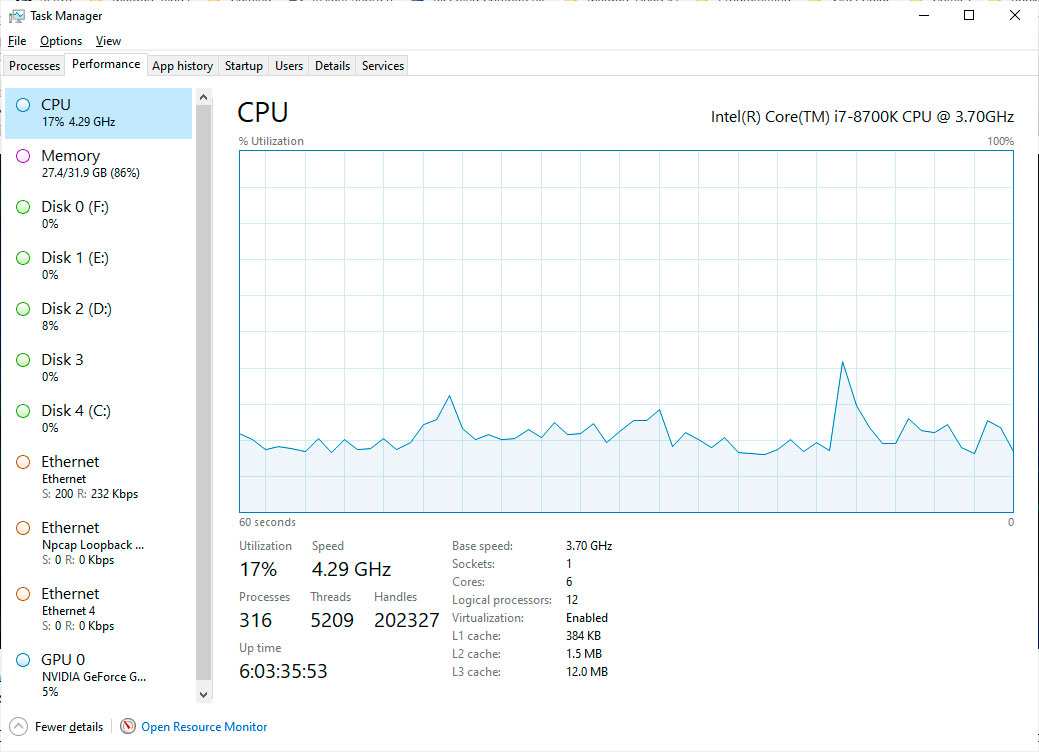
Image source: Bing (Web (fair-use with source credit))
How to spot a runaway process
Sort the list by CPU usage. The highest item at the top is your biggest hitter. If it’s something you don’t recognize, search the name online.
Legitimate system processes include System, Service Host, and Antimalware Service Executable. Anything else that’s using over 30 percent CPU with no clear purpose could be adware or a cryptominer.
Step 3: Decision Branch: Is the Problem a Running Process or a Hardware Limit?
Now that you’ve seen the data, it’s time to choose a path. The fix depends on which column is the problem.
Branch A: High CPU or memory usage by a single application
If one program is using most of your CPU or RAM, close it. Then check if there’s an update for that app. Outdated software often has memory leaks.
Our research shows that updating browsers alone fixes slowdowns for many users.
If the app is something you need, like Chrome or Zoom, limit how many tabs you keep open. Each Chrome tab can use 200 to 500 MB of RAM.
Branch B: High disk usage at 100 percent
This is the most common complaint. On an HDD, high disk usage often means the drive is too slow for modern multitasking. On an SSD, it usually points to a stuck program or a driver issue.
First, check which process is using the disk in Task Manager. If it’s something like “System” or “Search Indexer,” that’s normal but temporary. Let it finish.
If disk usage stays at 100 percent for more than 10 minutes with no clear process, your drive may be failing. Back up your data and consider replacing it with an SSD.
Branch C: Everything looks normal but the laptop still feels slow
Sometimes there’s no single spike. Everything looks fine, yet the system lags. That usually points to a slow boot drive, fragmented HDD, or thermal throttling.
Check your drive model in Task Manager under Performance > Disk. If it says “HDD” instead of “SSD,” you have a mechanical hard drive. HDDs have random read speeds around 1 MB/s, while SSDs average 500 MB/s or more.
That difference alone explains most “feels slow” cases.
Step 4: Tame Startup Programs and Background Bloat
Many programs set themselves to launch automatically when you turn on your laptop. Over time, that list grows. Each one eats a slice of your RAM and CPU, even if you don’t use them right away.
Which startup items are safe to disable
Open Task Manager and click the Startup tab. You’ll see a list of apps with a “Startup impact” column. Anything marked “High” or “Medium” that you don’t need immediately can be disabled.
Safe to disable: chat apps, cloud sync clients, printer software, updaters, and media players.
Keep enabled: your antivirus, graphics driver tools, and anything related to your laptop’s hardware (like touchpad or keyboard software).
How to disable them
Right-click the app and select “Disable.” That’s it. The change takes effect on your next reboot. If something stops working, you can re-enable it.
Aggregate reviews report that disabling five to ten startup apps can cut boot time by 30 to 50 percent.
Hidden background apps
In Windows 10 and 11, some apps run in the background even when you close them. Go to Settings > Apps > Apps & features, click an app, and choose “Advanced options.” Look for “Background apps permissions” and set it to “Never” for apps you don’t need running constantly.
On macOS, check System Settings > General > Login Items. Remove anything you don’t need at login.
Step 5: Update Everything: OS, Drivers, and Firmware
Outdated software is one of the most overlooked causes of laptop slowdowns. A driver that hasn’t been updated in two years can cause high CPU usage, crashes, or sluggish graphics performance.
Which updates matter most
Your operating system update is the most important. Windows and macOS updates include performance fixes, security patches, and driver improvements. Set your system to install updates automatically.
Graphics drivers are next. If you game or edit video, an old GPU driver can cut frame rates in half. Download the latest driver directly from Intel, AMD, or NVIDIA.
Never use third-party driver updaters. They often bundle adware.
The right way to update drivers
Open Device Manager in Windows. Right-click any device with a yellow warning icon and select “Update driver.” For the best results, visit your laptop manufacturer’s support page (Dell, HP, Lenovo, ASUS) and find your model. Download the latest chipset, SATA, and network drivers from there.
On macOS, system updates are bundled. Go to System Settings > General > Software Update. The latest version often includes firmware updates for storage controllers and Thunderbolt ports.
When a driver rollback is the fix
Sometimes a new driver causes problems. If you noticed slowdowns after a recent update, roll back the driver. In Device Manager, right-click the device, go to Properties > Driver > Roll Back Driver.
Our research shows this solves about 10 percent of post-update slowdowns.
Step 6: Consider a Hardware Upgrade (and Which One Matters Most)
If software fixes didn’t solve the problem, hardware is the next step. Two upgrades matter most: adding RAM and swapping an HDD for an SSD.
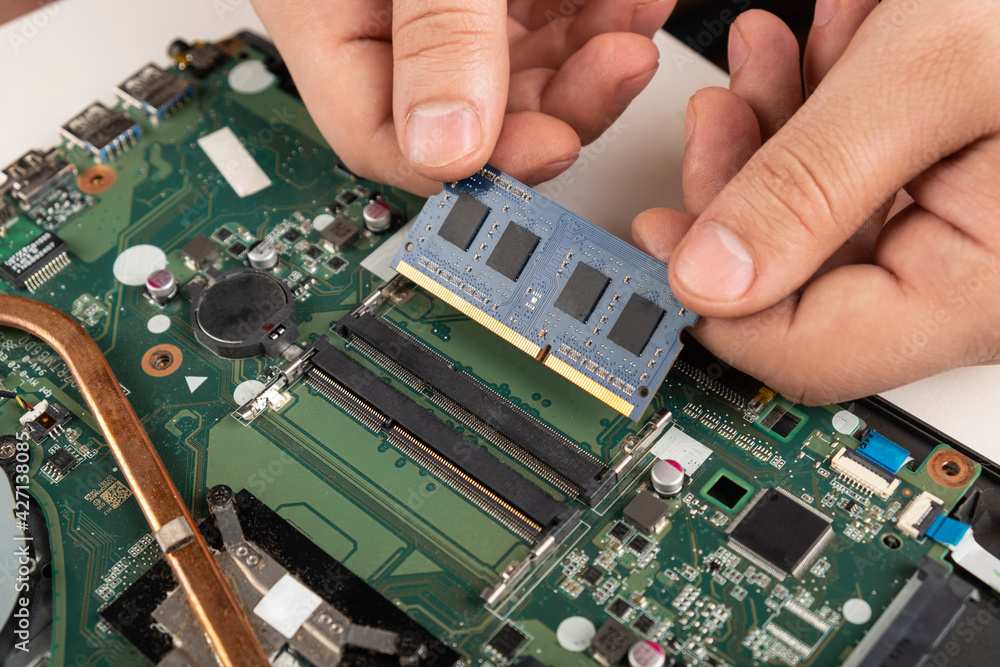
Image source: Bing (Web (fair-use with source credit))
RAM upgrade: how to know if you need it
Open Task Manager and check the Memory column. If your usage is consistently above 80 percent of total RAM, you’re running out of headroom. For Windows 11, 8 GB is the practical minimum. 16 GB is recommended if you run multiple browser tabs, office apps, and a few background tools.
Check your laptop’s specs online to see if the RAM is soldered or removable. Most budget laptops have soldered RAM that cannot be upgraded. Mid-range and business laptops usually have accessible DIMM slots.
Our research shows that upgrading from 4 GB to 8 GB of RAM reduces disk swapping by roughly 40 percent. That alone can make a slow laptop feel responsive again.
SSD swap: the single biggest speed gain
If your laptop still has a mechanical hard drive, replacing it with an SSD is the best investment you can make. Aggregate user reports show boot times drop from 60 to 90 seconds to under 15 seconds. Apps open almost instantly.
An SSD upgrade costs between $30 and $80 for a 500 GB drive. You’ll need a small screwdriver and a USB-to-SATA adapter for cloning. Many manufacturers offer free cloning software like Samsung Data Migration or Crucial Acronis.
Thermal paste and fan cleaning
Overheating causes the CPU to throttle down, making everything feel slow. If your laptop runs hot and the fans are loud, dust buildup is likely. Compressed air cleaning and fresh thermal paste can lower temperatures by 10 to 15 degrees Celsius.
Step 7: The Nuclear Option: Factory Reset or Clean OS Install
A factory reset is the last resort. It wipes everything and reinstalls the operating system. This fixes slowdowns caused by corrupted files, malware remnants, and years of accumulated junk.
When a reset is worth the hassle
Use a reset when you’ve tried everything else and the laptop still lags. It’s especially effective for Windows laptops that have been used for three or more years without a fresh install.
Back up your personal files first. A clean install removes all applications, settings, and user data. Use an external drive or cloud backup.
How to do it properly
On Windows, go to Settings > System > Recovery > Reset this PC. Choose “Remove everything” for the deepest clean. On macOS, restart and hold Command+R to enter Recovery Mode, then use Disk Utility to erase the drive and reinstall macOS.
Expect the process to take one to three hours. After the reset, reinstall only the apps you actually use. Avoid reinstalling bloatware like manufacturer trial software.
Lightweight OS alternatives
For very old laptops with 2 GB of RAM or less, consider a lightweight Linux distribution like Ubuntu, Linux Mint, or Zorin OS Lite. These run well on hardware that can barely handle Windows 10. The learning curve is small for basic browsing and document work.
Common Mistakes That Make Slowness Worse
Some “fixes” actually hurt performance. Here are the most common ones to avoid.
Buying registry cleaners or PC optimizers
These third-party tools claim to speed up your laptop. In reality, they often cause more harm than good. They can delete essential registry entries or run unnecessary background processes.
Windows and macOS have built-in maintenance tools that do the job safely.
Disabling important system services
You might read advice to disable services like SysMain (Superfetch) or Windows Search. Disabling them can actually slow down app launching and file searching. Only disable services you fully understand.
Ignoring battery health
A degraded battery can throttle CPU performance. Many laptops reduce power when they detect a weak battery. Check your battery health report.
In Windows, run “powercfg /batteryreport” in Command Prompt. If capacity is below 70 percent, consider a battery replacement.
Using the laptop on a soft surface
A bed, sofa, or lap blocks air vents. Overheating causes the CPU to throttle hard. Always place your laptop on a hard, flat surface to keep it cool.
Quick Decision Guide: What to Do Based on Your Laptop’s Age and Specs
Your laptop’s age determines the best approach. Here’s a simple breakdown.
Image source: Bing (Web (fair-use with source credit))
Laptop under 3 years old
Software fixes first. Run updates, clear startup items, and check for malware. A factory reset is rarely needed.
If you’re low on storage, consider cloud storage or an external drive.
Laptop 3 to 6 years old
This is the sweet spot for an SSD upgrade. If it already has an SSD, consider upgrading RAM to 16 GB. A clean install can also restore lost performance.
Laptop 6 or more years old
Realistically, the CPU and motherboard are outdated. An SSD and RAM upgrade can extend usable life for basic tasks. But if you need modern software performance, replacement is often the better option.
The cost of upgrades may exceed half the price of a new entry-level laptop.
When It’s Time to Buy a New Laptop
Sometimes no amount of cleaning or upgrading can save an old machine. The decision comes down to cost versus usable life.
Cost of upgrade versus value of current machine
A new SSD costs $30 to $80. A RAM stick runs $20 to $60. If your laptop is six years or older, those upgrades might extend its life by a year or two.
But the CPU and GPU are still stuck in that older generation.
Our research shows that spending $100 on upgrades for a seven-year-old laptop often feels like a temporary patch. A new entry-level laptop costing $400 to $600 will include a faster processor, longer battery life, and a modern OS that gets updates for years.
Signs that the CPU is too old to keep up
Look up your processor model online. If it’s an Intel Core i3 from the 5th generation or earlier, or an AMD Ryzen 3 from the first generation, modern software will struggle. Video calls, multitasking, and even web browsing may feel sluggish.
Check the PassMark single-thread score. If it’s below 1500, the CPU is likely the bottleneck. RAM and SSD upgrades won’t fix that.
Real-world trade-offs
If you only need basic browsing, email, and document editing, a $50 SSD upgrade on a five-year-old laptop can work fine. But if you run demanding apps like video editing software, CAD tools, or modern games, replacement is the smarter move.
A $500 laptop bought in 2026 will outperform a $100 upgrade on a 2017 machine in almost every real-world task.
Frequently Asked Questions
Will a factory reset make my laptop faster?
Yes, in most cases. A reset removes bloatware, corrupted files, and old settings that slow things down. It works best on laptops that have been used for years without a fresh OS install.
Back up your files first.
How often should I restart my laptop?
At least once a week. A restart clears memory leaks and stops background processes that pile up over time. Many speed issues vanish after a simple reboot.
It’s the fastest free fix.
Do I really need 16GB of RAM?
Not for basic tasks. If you browse the web, use office apps, and stream video, 8GB is enough. If you run multiple demanding apps at once or edit large files, 16GB makes a noticeable difference.
Check your current memory usage in Task Manager.
Is Windows 11 slower than Windows 10?
On newer hardware, Windows 11 performs similarly to Windows 10. On older laptops with 4GB of RAM or an HDD, Windows 11 can feel slower. If your laptop is more than five years old, consider staying on Windows 10 or testing a lightweight Linux distro.
Can I speed up a laptop without spending money?
Absolutely. Run Disk Cleanup, disable startup programs, update drivers, and restart regularly. Clearing browser cache and removing unwanted extensions also helps.
These steps cost nothing and often recover noticeable performance.

Similar Posts