Do I Need an iPad Pro and a MacBook?
Apple’s lineup can feel like a puzzle. On one side, the iPad Pro offers a touch-first, ultra-portable canvas with Apple Pencil support. On the other, the MacBook delivers the traditional desktop experience, full‑fat software, and a familiar keyboard and trackpad. Both are powerful, but do you really need both? The answer depends on what you create, how you work, and where your budget sits. This guide breaks down the strengths and limitations of each device, explores real‑world scenarios, and helps you decide whether owning both is a productivity multiplier or an unnecessary expense.
Understanding the iPad Pro’s Strengths and Limitations
The iPad Pro (M4, 2024) is a tablet that thinks it’s a laptop — and for many tasks, it succeeds. Its Liquid Retina XDR display, combined with Apple Pencil hover and a vast library of touch‑optimized apps, makes it a go‑to device for illustrators, note‑takers, and mobile professionals.
Strengths
- Portability and cellular connectivity: The 11‑inch model weighs about 440 grams, and optional 5G lets you stay connected almost anywhere. This makes it ideal for fieldwork, site visits, or commuting.
- Apple Pencil and touch precision: The second‑generation Apple Pencil snaps on magnetically for charging and offers pixel‑perfect pressure sensitivity. Digital artists, architects, and students who scribble notes in apps like GoodNotes or Notability find this indispensable.
- Media consumption and light productivity: The tandem OLED display delivers deep blacks and high brightness, while the four‑speaker audio system creates a cinema‑like experience. For reading, web browsing, video calls, and writing in Pages or Google Docs, it’s exceptionally capable.
- App ecosystem and iPadOS 18: With Stage Manager, true external display support, and a growing number of pro apps (Final Cut Pro for iPad, Logic Pro, DaVinci Resolve), the iPad can now handle more complex workflows than ever before.
Limitations
- Software constraints: iPadOS still doesn’t run full macOS applications. You can’t install Xcode, run Docker containers, or use the full Adobe Photoshop with all plugins. Alternatives exist, but they often lack the same depth.
- Keyboard and trackpad nuances: The Magic Keyboard is excellent, but keyboard shortcuts and trackpad gestures don’t mirror the MacBook’s completely. Heavy Excel users or those who rely on intricate mouse‑driven interfaces may feel hamstrung.
- Storage ceilings and pricing: A 1TB iPad Pro with Magic Keyboard costs as much as a MacBook Pro — yet you still have a tablet‑class file system. If you work with large video files or massive photo libraries, local storage can become a bottleneck.
- Multitasking that still feels cramped: Stage Manager improves windowing, but the 11‑inch screen is small for side‑by‑side spreadsheets and a reference document. The 13‑inch model helps, but it’s still not as fluid as a desktop OS.
Understanding the MacBook’s Strengths and Limitations
The MacBook (Air M3 or Pro M4) is a proven workhorse. It runs macOS, which unlocks a universe of professional software, terminal‑level control, and peripheral support that the iPad simply can’t match.
Strengths
- Full desktop software: Adobe Creative Cloud apps, Final Cut Pro, Logic Pro, Xcode, MATLAB, and thousands of other industry‑standard tools run natively and reliably. There’s no compromise on features or plugins.
- Keyboard and trackpad excellence: The Magic Keyboard with scissor‑switch keys and the large Force Touch trackpad provide tactile feedback and precision that make long writing sessions, coding, and spreadsheet work comfortable.
- Storage and RAM headroom: MacBook Pro models can be configured with up to 8TB of storage and 128GB of unified memory. This is essential for video editors, 3D artists, and data scientists.
- Multi‑window workflow: macOS lets you stack windows, use Mission Control, and create multiple desktops. A 14‑inch or 16‑inch display with high pixel density lets you keep a research paper, a code editor, and a terminal visible simultaneously.
- Battery longevity (real‑world): The MacBook Air M3 can deliver 15–18 hours of web browsing or video playback. The Pro models with M4 chips push even further, often lasting a full workday without tethering to a charger.
Limitations
- Portability trade‑offs: Even the 13‑inch Air is heavier than an iPad Pro and lacks a touchscreen. You can’t fold it flat for sketching, and you can’t use it comfortably while standing on a train.
- No Apple Pencil support: Creative professionals who rely on direct screen drawing or handwritten annotations must use a separate graphics tablet. The MacBook’s display is not pressure‑sensitive.
- Cost of repair and upgrades: MacBooks are sealed units. RAM and storage are soldered, so you pay upfront for future‑proofing. A base model might feel restrictive after a few years.
- One‑device mindset: Unlike an iPad, a MacBook doesn’t double as a lightweight e‑reader or a handheld note‑taking slate. It’s a laptop first, and that form factor can be overkill for quick consumption tasks.
When One Device Is Enough
If your workflow fits neatly into one category, you may not need both. Here’s how to identify that sweet spot.
Choose the iPad Pro if you:
- Primarily create with a stylus (illustration, digital painting, handwritten notes).
- Need a device for reading, annotating PDFs, and light productivity.
- Travel frequently and value a 5G‑enabled, ultra‑light device.
- Rarely run software that requires macOS (e.g., you use web‑based tools, Canva, or iPad‑optimized apps).
For example, a freelance illustrator who works in Procreate and handles emails on the go can do everything on an iPad Pro. Adding a MacBook would only duplicate what they already have.
Choose a MacBook if you:
- Rely on desktop‑class applications like Xcode, full Adobe Creative Cloud, or development environments.
- Use a keyboard and trackpad for most of your day, with complex file management.
- Need a larger screen or multiple external monitors for multi‑window productivity.
- Record, edit, and mix audio — whether you’re a podcaster or musician, the MacBook’s software ecosystem is broader.
A content creator who edits 4K video in Final Cut Pro, manages a large audio library, and occasionally writes code will find a MacBook indispensable. The iPad Pro would be a secondary luxury, not a necessity.
When You Might Need Both
For some professionals, the combination of an iPad Pro and a MacBook creates a seamless, two‑screen ecosystem that boosts productivity.
Scenario 1: Mobile creative pros
A photographer might import RAW files on a MacBook Pro at a coffee shop, then use the iPad Pro as a second display with Sidecar to show adjustments to a client. The iPad Pro also becomes a portable portfolio. For video creators, the iPad can serve as a teleprompter or a dedicated preview monitor. Getting the proper lighting setup for your home studio, selecting the right microphone, and reducing background noise are all critical steps — and the iPad Pro can run your recording checklist while the MacBook handles the edit.
Scenario 2: Students and researchers
A student might take handwritten notes on the iPad Pro during lectures, then open the same notes on a MacBook to write a paper. The iPad Pro becomes a lightweight digital textbook, while the MacBook handles heavy research, citation management, and data analysis.
Scenario 3: Developers and technical writers
A developer who needs Xcode or Docker on macOS may still use the iPad Pro for sketching app architectures, reading documentation, or testing touch‑based interfaces. For actually writing code, using AI‑powered coding assistance can speed up troubleshooting and boilerplate generation. The iPad becomes a companion for brainstorming and organizing collaborative AI research notes, while the MacBook carries the heavy compile‑and‑debug load.
Scenario 4: Executives and remote workers
A manager who travels often might use the iPad Pro for quick email triage, Slack, and video calls during the day, then switch to a MacBook at the hotel for deeper work. The iPad Pro’s cellular option ensures connectivity even when Wi‑Fi is spotty.
Key Factors to Help You Decide
| Factor | iPad Pro | MacBook | Both? |
|---|---|---|---|
| Primary input | Touch, Apple Pencil | Keyboard, trackpad | If you genuinely need both daily |
| Software needs | iPadOS apps, some desktop‑class apps | Full macOS, any desktop app | If you must run macOS-exclusive tools |
| Portability | Ultra‑light, 5G option | Heavier, no 5G | Complementary for travel |
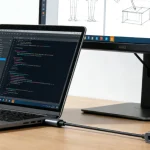
| Screen real estate | 11″ or 13″, single display (or external) | 13″–16″, multi‑monitor support | MacBook as primary, iPad as second display |
| Budget | $799–$2,399+ (plus accessories) | $999–$3,499+ | Evaluate if second device adds $1,000+ in value |
| Battery life | 10–10.5 hours (real‑world) | 15–18 hours (Air), 12–14 hours (Pro) | iPad can extend total workday |
| File management | Files app, limited folder hierarchy | Finder, terminal, robust file system | MacBook for heavy file ops |
Frequently Asked Questions
Can the iPad Pro replace my MacBook entirely?
For users who live in a browser, use iPad‑optimized creative apps, and don’t need macOS‑exclusive software, the iPad Pro can serve as a primary computer. However, if you depend on specific desktop applications, advanced file management, or a fluid multi‑window environment, it’s not a total replacement yet. iPadOS 18 has closed many gaps, but the fundamental architecture still differs from macOS.
How well does the iPad Pro work with an external keyboard and mouse?
The Magic Keyboard and third‑party Bluetooth keyboards turn the iPad Pro into a laptop‑like device. Mouse and trackpad support is precise, but some cursor behaviors and right‑click options differ from macOS. You can customize pointer speed and button assignments, but the experience remains touch‑first, not cursor‑first.
Does the MacBook support touch input or Apple Pencil?
No. MacBook displays are not touch‑sensitive, and Apple Pencil is not compatible. If you need to draw or write directly on the screen, you’ll need a graphics tablet or an iPad running Sidecar (which mirrors the Mac display but doesn’t add touch to the Mac itself).
Which device has better battery life for all‑day work?
The MacBook Air (M3) typically lasts 15–18 hours for light‑to‑moderate use, while the iPad Pro (M4) delivers around 10–10.5 hours. If you’re constantly on the move and can’t recharge, the MacBook Air wins. However, the iPad Pro’s cellular model can keep you connected without tethering to your phone, which can be a different kind of battery advantage.
Is it worth buying both if I’m a student on a budget?
Probably not. A MacBook Air M1 or M2 (often available at a discount) covers writing, research, and most student software. Use the savings for a notebook and pen. If you really want digital note‑taking, a base iPad with a first‑generation Apple Pencil can complement the MacBook without breaking the bank. The iPad Pro’s extra power is often overkill for typical student workloads.
What about using Sidecar or Universal Control?
Sidecar turns your iPad into a secondary Mac display, which is great for extending your screen. Universal Control lets you use a single keyboard and mouse across both devices. These features make the two‑device setup more fluid, but they don’t fundamentally change the “one device vs. two” equation — they just reduce friction if you already own both.
Conclusion
The question “do I need an iPad Pro and a MacBook?” doesn’t have a universal answer. It’s a personal calculation based on your daily tasks, creative habits, and financial comfort. The iPad Pro excels at portability, touch, and stylus‑driven work, while the MacBook dominates with desktop software, extended battery life, and a mature keyboard‑and‑trackpad workflow. For many, one device will cover 90% of what they do. For others, the combination unlocks a productivity loop that neither device can achieve alone.
Before you buy, map out your typical week. List every app you open and every task you complete. If you find yourself regularly needing a touchscreen, Apple Pencil, and ultra‑portability alongside a full desktop OS, then owning both may be the right call. If not, invest in the one that fits your core workflow and rent the gap — borrow a tablet, use a paper notebook, or rely on a single device that does the job well. The key is not to chase the shiny new thing but to build a setup that helps you do your best work, every day.

Similar Posts